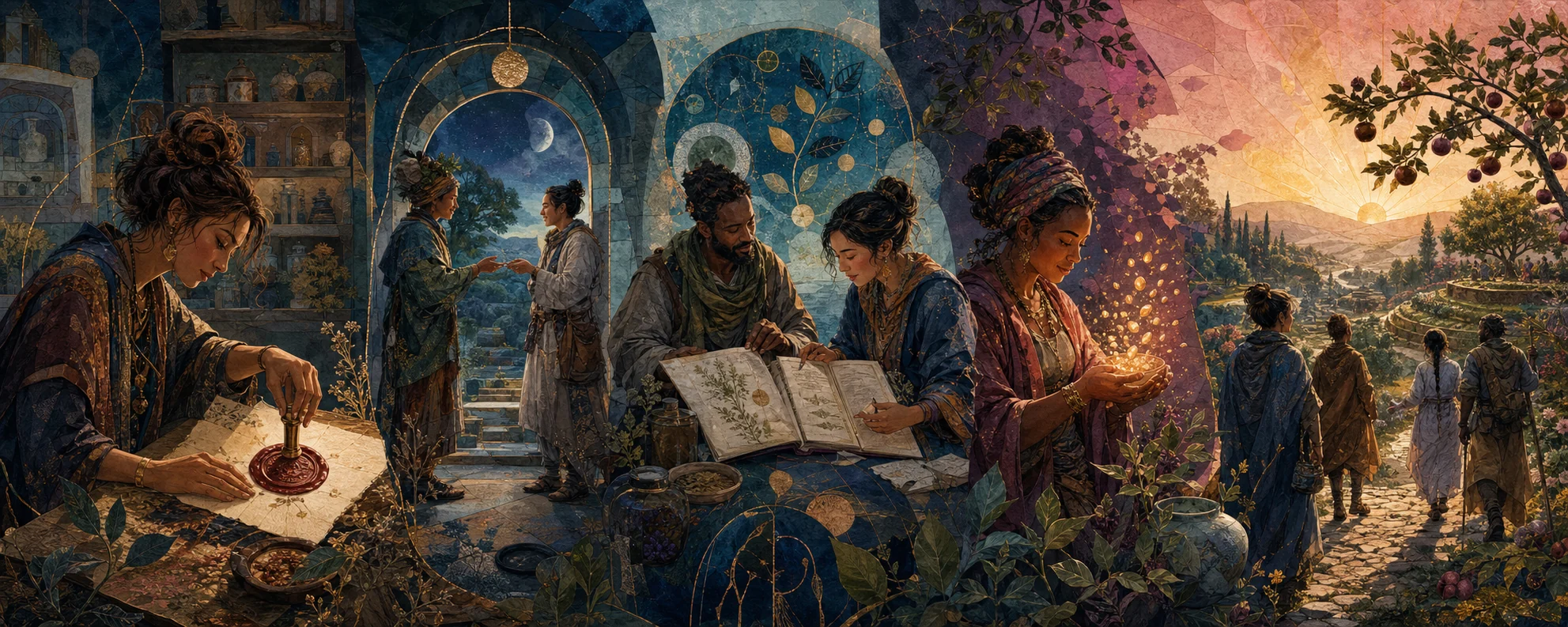
The room where the serial keeps your place. Pick up where you stopped, keep the whole book
for reading offline, see when the next chapter lands, search every chapter, and send a note
to the scribes who write it. Everything here is also a spell: a line of Spw you can learn
by tapping it, then cast by typing.
For the curious, and for the writing teams who will join: who does what, how a chapter is
seeded and set, and the forces every chapter has to answer to.
Offices of the scriptorium
Roles wear guild names. Open a veil only if you want the workshop reading.
Chamberwright
Seeds a chapter until it can stand alone as a room in the monument.
Workshop reading
Lead narrative craft—arc, scene pressure, continuity with the living canon.
Seal-keeper
Guards what may be claimed in public: totals, marks, and sponsored thresholds.
Workshop reading
Editorial & integrity—what can be published, what remains rumor, how patronage appears.
Motif gardener
Tends images, names, and recurring objects so the world remains harvestable.
Workshop reading
Brand & systems design—motifs, visual seeds, reusable assets across chambers.
Fool’s desk
Keeps wonder in the room when the tale grows too tidy.
Workshop reading
Values and process review that restores play—without a lecture, and without sanding off surprise.
How a chamber is made
A mystery is produced, not announced. Harvest a pressure, measure it so the count can be
checked, file a key that only gets smaller, then emit a turn that leaves a slip.
A false slip is refused. That refusal is the proof the walk means it.
Harvest falls out as a scene. A pressure becomes a scene the land can hold.
How a chamber is seeded
Name a pressure.
A real process or value under stress—audit, delivery, negotiation, memory.
Dress it in the land.
Commons Scale, kitchen, council, grove: fantasy names that keep the scene playable.
Leave a second reading folded.
Recognition for those who have lived the pressure; pure adventure for everyone else.
Set the stone on the calendar.
Releases on the 13th and 26th keep the monument on a rhythm the audience can trust.
Brand development · carried by experience
The wonder path
A durable identity is easier to piece together when every layer answers the next question.
Lore.Land uses five movements; owners and operators can follow the same path without turning
the story into a presentation.
Promise becomes encounter, evidence, memory, and a reason to return.
Promise · What is said? A seal, claim, or invitation sets an expectation people can repeat.
Encounter · Where is it felt? A chamber, service moment, or threshold lets the promise meet a real need.
Evidence · What makes it believable? Consequences, records, behavior, and material choices show whether the claim survives contact.
Memory · What travels afterward? A motif, phrase, feeling, or useful result gives people something distinct to carry.
Return · Why come back? Rhythm, unfinished responsibility, and renewed value create continuity without demanding constant attention.
UX reading · make the path traceable
Each major page should reveal its promise quickly, identify who experiences the consequence,
offer evidence at the depth the visitor chooses, and provide one clear next route. Wonder supplies
emotional charge; orientation and accessibility help that charge survive the journey.
Material culture · evidence you can touch
Cabinet of working artifacts
Objects let the world carry an idea before anyone has to name it. Each fragment below can
move through a chamber as evidence, trouble, or gift—and can help a real team ask what its
promises require in practice. They are not trophies. Their meaning changes in use.
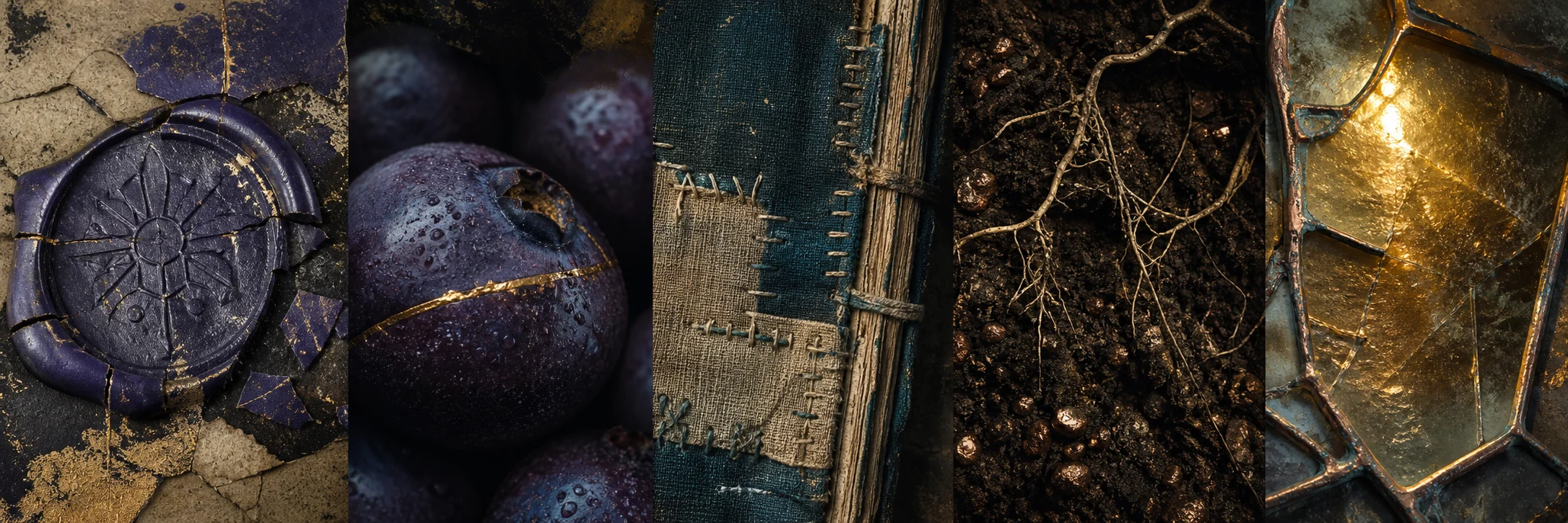
Material signalFive objects wait for consequence.
Wax · berry skin · ledger cloth · living soil · solar glass
Claim · provenance
Seal shard
A promise remains public even after its perfect surface breaks. The crack becomes part of the record.
Workshop reading
State the brand promise clearly enough to test. Keep its origin visible, then show how the claim behaves under pressure.
Attention · relation
Awakened berry
A boonberry sometimes notices the world noticing it. It may answer, refuse, remember, or simply return to being fruit.
Workshop reading
Treat feedback as a relationship, not a command. A living signal may complicate the plan without becoming a product feature.
Evidence · repair
Repair book
Beside the clean ledger sits another volume: spills, injuries, exceptions, mending, and the names of those who returned.
Workshop reading
Measure recovery as seriously as delivery. Operational truth includes the work required when an experience fails.
Capacity · succession
Root sample
The field keeps a portion of each harvest below the visible count, where next season can still find it.
Workshop reading
Reserve time, cash, soil, and attention for renewal. Capacity is not waste merely because it has not yet become output.
Return · distribution
Solar pane
Shared light gathers at the copper edge and leaves on a rhythm the district can plan around.
Workshop reading
Infrastructure turns wonder into dependable value. Make the return cadence and its distribution legible to everyone affected.
Persona development · provisional lenses
Four forces acting on the same monument
These are behavioral lenses, not portraits, so they carry no names. Each is written as a Spw
expression: the operator is the move it makes, the frame is its trope, the body is the physics
it exerts. Any visitor may hold all four in one session. The steward is the primary design lens;
the others keep the experience honest around that center.
Primary · owner-steward
^[steward]{inertia} Building for continuity
Inertia — the tendency to keep a heading. Continuity is a kind of mass.
Balances cash, reputation, team capacity, and long-term direction. They want differentiation they can operate—not a story detached from delivery.
Arrives asking: Is this useful to the business I am responsible for?
Needs: a fast conceptual map, credible evidence, and a next decision.
Leaves with: language for a promise and the system required to keep it.
Operator · delivery steward
&[keeper]{friction} Protecting the handoff
Friction — the force where two surfaces meet. A promise touching the ground.
Sees where a public claim meets inventory, labor, tooling, and exceptions. They want the experience to acknowledge operational truth.
Arrives asking: What changes after someone believes the promise?
Needs: traceable flows, edge cases, ownership, and repair routes.
Leaves with: a shared story for aligning message and delivery.
Community · consequence holder
?[chorus]{flux} Testing who receives
Flux — what actually passes through a surface. Value measured where it arrives.
May be a customer, member, neighbor, or partner. They judge the promise by its lived distribution, not by the confidence of its language.
Arrives asking: Was this made with people like me in the count?
Needs: plain routes, visible provenance, respect, and a way to answer back.
Leaves with: enough agency to trust, question, share, or decline.
Builder · curious collaborator
~[apprentice]{resonance} Looking for usable patterns
Resonance — a system answering a frequency it already holds. Patterns that ring.
Reads for motifs, systems, and ways to contribute. They want craft that can be inspected without draining the world of mystery.
Arrives asking: How is this made, and where could I connect?
Needs: reusable handles, boundaries, examples, and marked thresholds.
Leaves with: a route into collaboration rather than a vague invitation.
Experience design · first commitments
Keep wonder legible
Two honest entrances
Story-first visitors enter a chamber. Operator-first visitors enter through topics, the commons, or this workshop map.
Depth by choice
The primary layer carries meaning alone; details and second readings add craft language without becoming prerequisites.
Consequence before abstraction
Every concept points toward a person, place, decision, or resource that changes when the promise succeeds or fails.
One strong continuation
Primary navigation uses familiar language. Each page offers a clear next route while quieter paths remain available.
Early validation signals
Can an owner state the public promise and its operational consequence after one short visit?
Can a visitor identify who receives value—and who bears failure—without opening every veil?
Can each persona find a relevant next route without learning the site’s internal vocabulary first?
Can a returning reader recognize a motif and use it to recover where they left off?
Are patronage, evidence, and speculative worldbuilding distinguishable without breaking immersion?
Patrons and neighbours
Who keeps the lamps lit
Patron seals
A seal can fund a chamber, a tool route, a snack, or a recipe without owning the canon.
Marks stay visible as patronage. Empty pedestals stay empty on purpose.
Boof appreciates a blueberry more than she enjoys one, which leaves room for treats the story can stand next to.
Open pedestal
Unclaimed mark
A chamber, motif bed, or tool route can carry a patron seal here.
Snack pediment · open
Treat path
A sponsored snack with a true label: who made it, what it costs,
and why it belongs near a dog who works for the land.
Recipe leaf · open
Kitchen handle
A blueberry or boonberry recipe people can cook and share.
Food beside the story—not a rewrite of it. Editorial stays with the scriptorium.
Example mark
Atelier
Illustrative only: a quiet threshold to the craftsperson who raises neighboring monuments.
Seals remain legible as patronage—never disguised as neutral narration.
Sponsored routes keep provenance: who funded, what was funded, when the stone was set.
Editorial judgment stays with the scriptorium; a seal buys presence, not rewrite rights.
Paid links appear as marked thresholds, not hidden doors.
Snack and recipe seals sit beside Boof’s appreciation of fruit: sensory treat, not a rewrite of the canon.
Raise a neighboring monument
Lore.Land is itself the demonstration: entertainment with a spine, process encoded as place,
and room for marks that fund the work. If you want something of the same order for another
land—serial, brand world, or long-form surface—the atelier is the door, not this page’s center.