At dawn, Boof digs a warm egg out of a frozen furrow — an unspent wish, humming like a held breath, that every map in Boon.land refuses to write down.
Chapter One: Dawn in Boon.land
In which a dog finds an egg the maps will not admit.
A wish is not a thing. It is a direction the world has not agreed to turn yet.
8 min read
The Warm Furrow
Dawn smelled of frost and wet fur. Boof put her nose to the ground and read the field the way she read it every morning: loam-dark under the rime, burr-rough along the fence-foot.
Everything was where it belonged. The latch lifted at the kitchen. The bucket knocked the well. A blackbird tried the same few notes until one pleased it. Beneath the berry rows, the torch-ants kept their little hearths, and their patient magic warmed the roots through winter; above them, the boonberries slept under ice, each holding a drop of light. What light they let slip ran downhill with the meltwater to the miller's pond, which is why that pond never freezes quite dark.
On the coldest nights, when the frost split a furrow, you could see the hearths at work: a pin of light no bigger than a seed, carried down along a root by something with more legs than Boof cared to count, and behind it another, and another, a whole small procession going home along streets no map had room for. Boof did not dig. Some business is not a dog's, and the ants had never once asked her for anything.
Torch-ants were businesslike, and very particular about torches. If one went out at the wrong corner, the whole street stopped until it was relit from the right one. Children lay with an ear to the frost to hear them keeping their corners: a dry, small ticking, like seeds in a gourd.
Boof followed the rows past the fence that leaned into last year's weeds, past the scraping-post where the miller knocked the loam off his boots. She sniffed a root here and there, and the field gave back its usual answers: vole, frost-bitten clover, the sour ghost of a fox who had thought better of it.
Boof knew this field. She worked for the land, wherever the fences stood. Nobody paid her, and nobody had needed to; the land kept her the way it kept the ants, without either side signing anything. She did not especially like blueberries. She appreciated them, which is a different thing, and which the field seemed to know.
She sniffed. Stepped. Stopped. One furrow was warm. Too warm. Beneath it, the ants had stopped working. Or not stopped — gathered, the way they gather at a hearth when a new coal is laid.
Boof dug. First frost, then soft earth, then a little cloud of steam. At the bottom lay an egg the size of a curled cat, dark as an old lamp.
She touched it with one paw. It hummed.
The steam climbed past her ears, met the cold, and came down as snow that did not sting, because it was warm. Children have a name for warm snow, and a way of making it they explain only to other children: a hearth-drift. Nobody had taught the field how.
Down the walls of the hole, the torch-ants were already at their business. Her digging had cut one of their streets clean through. They did not complain; they carried their torches around the break in single file, a detour of pinpricks bending across the shell. One stopped and held its torch against the egg, the way a lamplighter tests a wick, then went back down a shade brighter.
No nest. No tracks. No mother-scent. She went around the hole once more, slowly. Whatever had brought it here had left no way to follow.
Inside the shell, an unspent wish waited. Boof heard only the hum.
Ant-warmth smelled earthy and even, like bread left under a cloth. This was sharper. A candle just blown out. Boof knew the paths to the kitchens, the mill with its flour-pale doorstep, and the grove nobody liked to name after dark; after supper people said the downhill trees, as if the grove might hear its name and come up to see what was wanted. She had never found an egg on any of them. Certainly not one that warmed a whole furrow.
She rested her chin on the rim of the hole. The egg hummed against the earth. Under her chin, she felt it answer.
She would have preferred a trail. Trails usually ended with something you could eat: a dropped crust, a vole, once a whole wheel of cheese gone into the ditch to think things over.
When a Berry Remembers
Every boonberry had been a blueberry once. A wish had passed over it on the way to being granted, leaving a little of its light behind. Most slept through everything: snow, crows, harvest.
The town used them for supper and lanterns: berry-lamps in jam jars on the porch posts, crust-gold pies at harvest. Nobody ate one warm. By the time a boonberry reached a table it had given its light to a lamp or a pie, and what was left was sweet and ordinary. Boof had never wondered what the light was for. She had been busy.
The berry nearest the egg shed its frost. A gold seam opened in its skin with a small sound, like a thumbnail on a jar lid. Its light leaned toward the shell, then past it, down the slope.
The next berry turned. Then the next. Frost slid off the leaves in glass-clear sheets and broke on the furrows like a tray of cups set down too fast. Row by row, a low glow led toward the grove. Boof followed with her nose. The berries remembered this hum. Long ago, it had passed them going the other way.
Boof put her nose to the nearest berry, and it told her something. It did not speak; it was more as if she remembered being told. Trees. The sack warm against her ribs. A long note out of the dark, rather pleased with itself. Nothing in it was wrong. Then it was a cold berry with a gold seam, and she could not have said whether it had shown her what was coming or reminded her of something that already had. Boonberries only ever foresee kindly, the field-hands say. Whether kind things are all they can see, or all they will tell, nobody has thought to ask them.
She looked back at the hole. Something had come home. Why had nobody come to fetch it?
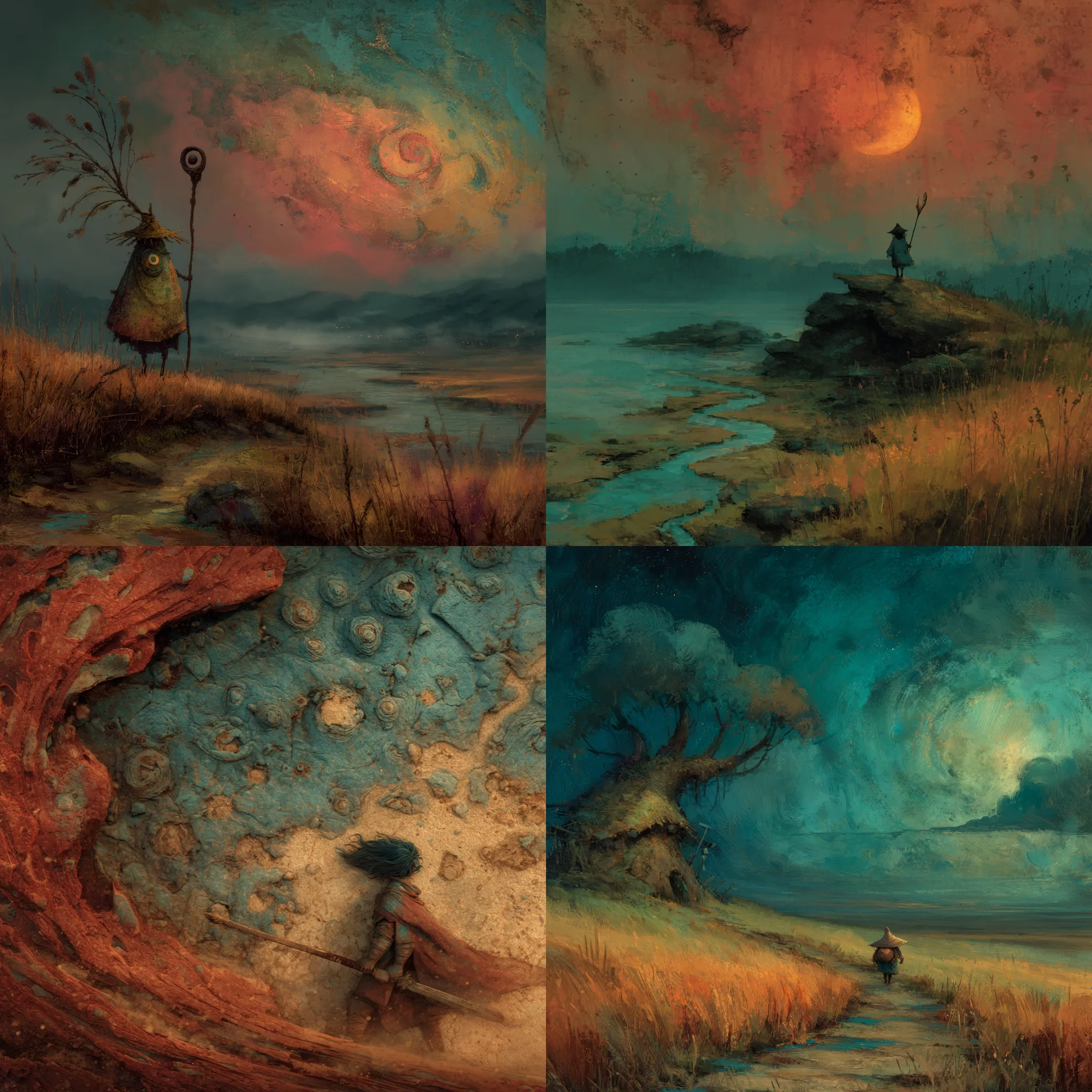
The Maps That Look Away
Before the frost was off the fences, Boof had carried the egg to the map-house in an old feed-sack. It was warm as a loaf and considerably heavier. She set it on the reading table. The archivist fetched a book.
The map-house smelled of oak-gall ink and cold slate. Along the back wall ran the drying-line, where new maps hung by their corners like washing over a slate trough. In a loaf-wide gap between rolled maps in the rafters, a young shelf-owl sat as if it had been shelved there.
Along a fold in the map, two roads touched. Boof knew those roads. A day's walk lay between them. Outside, a cart bell rang beneath the window.
The archivist smoothed the fold. The bell dwindled to a far, thin chime. “Leave room for the path,” he murmured, to the map or to the bell, and did not say which path.
Boof lifted her head. The archivist put a press-stone on the crease. Neither looked away first.
His press-stones sat along the table's lip, river-flat, six in a rack cut for seven. One is always missing; it is the first thing an apprentice learns and the last thing anybody finds.
Then he tried to enter the egg in the book. First, as archivists do, he pencilled it small in the margin in the makers' old shorthand, to see whether it would bear ink: .[egg], a thing that stays where it is put. The pencil skidded. He rubbed it out and tried ~[egg], a thing still on its way. That one held, faint as a hair.
So he dipped the pen. Egg, one. Dawnward field. Unclaimed. The ink gathered into beads and rolled off the page.
He tried a second pen, and then the good steel nib he kept for boundary disputes. Boof waited.
Maps keep what has happened. An unspent wish has not happened yet, and the page had nowhere to put it.
At last he pegged the page on the drying-line, since a stubborn entry sometimes sets when nobody is watching. The beads ran down and dropped into the trough until the page hung clean as a washed collar, all but the pencilled tilde. Below, the ink sat in one black drop and would not mix with the water.
He unpegged the page and laid it in the book beside the old field map: an ordinary field, in some long-dead surveyor's brown ink. “First ink stays,” he said. Nobody scrapes the first hand on a map; whatever comes after goes in pencil beside it, so whoever opens the book next can see what changed, and what it changed from. Beside the ordinary field, faint as a hair, the tilde waited.
The archivist wiped the table. Boof watched the stone. That, at least, he had known how to hold down.
Following the Hum
Outside, the berries still leaned toward the grove, every row combed one way like wet fur. Boof had spent the morning asking a book. The field had been pointing all along.
She settled the feed-sack against her chest, where a pup might ride. A fine gold crack had opened at the egg's crown. It looked like a door left slightly ajar. The hum kept its steady measure. Her paws found another.
Down the slope. Past the fogged cold-frames, past the last row, to the sloe hedge where the field gave up being a field. There she paused. Behind her stood a house full of maps. Ahead lay the way the berries remembered.
In the hedge-bottom lay a scatter of baneberries, plum-black, a thorn on every stem, dropped where nobody picks. Boof smelled what they were saying before she reached them, cold and very sure of itself: that whoever carried a warm thing into the grove would come out without it. Baneberries tell you what will go wrong, the field-hands warn, and then it goes wrong because you were told. Boof put a paw on the nearest, the way the field-hands do, and leaned. It split with a small sour sound and said nothing more.
She went ahead.
Evening laid long light across the field. Boof was hungry; somewhere uphill a kitchen was frying onions, and the smell followed her like a dog that had not been told to stay. The egg was warm. For a while, that was all. Behind her, the berries glowed under their leaves. Ahead, the first trees crowded close.
Then a sound came out of the grove. HONK.
Long, bent, and rather pleased with itself. Like a goose that had learned jazz. Boof stopped with one paw raised. The egg's hum slipped into time with it. She had heard it once already, that morning, with her nose in a berry, and could not have said which time was the first.
High over the treeline, nine geese crossed the last light in a ragged, swinging line and answered, each honk a little behind where a sensible goose would put it. Jazz-geese, people called that kind, and shut their windows.
She waited for a second note from the grove. Leaves stirred. Nothing more.
She put her paw down and entered the trees.
Step into the scene
vantage the mouth of the grove at sunset, Boof a dark shape against amber, the treeline swallowing the light ahead
light level amber behind, deep teal shadow under the trees ahead; the egg the one steady warm point
scent warm stone of the shell, cold coming up from the grove, the sun leaving the field
- the berry rows behind glow like banked coals, all leaning one way
- the egg's crown-crack shows a thin line of gold in the dusk
- a single far-off honk hangs in the air over the first dark trees
- the trail ahead is open and unwished
- nine geese cross the last light in a ragged swinging line, honking a beat off
The chapter in SpwWhat it is made of, and what you have found of it0 of 25 found
^chapter[1]{
  .rooms[ ~{warm_furrow}@boof .[furrow_rim]@boof =[berry_row]@the_berries #{map_house}@the_archivist
    !<sloe_hedge>@boof &(grove_mouth)@boof ]
  @told_by[narrator boof]
  $ink $steam $berry
  *wonders{ ?room_1 ?room_4 ?room_4 ?room_4 }
  &met[?room_1 ?room_1]
  =palette[pool]
  ~berries{ boonberry baneberry $boneberry[roast_chestnut_and_sage] }
  &harmonies[ <torch_ants roots> <roots boonberries> <boonberries pool>
    <pool flour> <frost torch_ants> <egg torch_ants> ]
}.rooms- Six rooms: two [ ] windows, two { } rooms, a ( ) gathering and a < > passage; four kept by Boof, the rest by the berries and the archivist.
@told_by- Told by the narrator and Boof.
$- Made most of ink and line, then steam and warmth, then boonberries.
*wonders- Four wonders are first met here; look in rooms 1 and 4.
&met- Two are met here for the first time; look in room 1.
=palette- Its palette is the pool, earned a layer at a time: where the berries' light collects at night, and Boof checks it on her rounds.
~berries- Here boonberries foresee and baneberries foretell; a boneberry in this chapter tastes of roast chestnut and sage.
&harmonies- The ants warm the roots. Warm roots keep the berries in their light. The berries let their light run down to the pond. The pond turns the mill. The frost holds still while the ants work under it. The ants take the egg for a new coal. And five more on Boof’s map.
Every expression the chapter holds, by its sigil. What you have found is lit, and takes you to where it lives; the rest say where to look.
potentialwhat lasts, or might0 of 5
~{warm_furrow}@boofRoom 1 of 6: read it to its end.Look in room 1~ ?A berry, named in room 1.Look in room 1~ ?A foreshadowing, marked in room 4.Look in room 4~ ?A foreshadowing, marked in room 5.Look in room 5~ ?A berry, named in room 5.Look in room 5
perspectivewhose eyes0 of 5
@ ?Something keeps the field warm from underneath.Look in room 1@ ?Someone you meet in room 1.Look in room 1@ ?Someone you meet in room 1.Look in room 1@ ?Someone guards the empty places on the shelves.Look in room 4@ ?A honk with a swing to it.Look in room 6
confluencewhat meets and stays itself0 of 2
& ?Snow that falls warm.Look in room 1&(grove_mouth)@boofRoom 6 of 6: read it to its end.Look in room 6
actionwhat happens at once0 of 1
!<sloe_hedge>@boofRoom 5 of 6: read it to its end.Look in room 5
annotationwhat is said, or marked0 of 7
# ?A motif, marked in room 1.Look in room 1# ?A motif, marked in room 3.Look in room 3#{map_house}@the_archivistRoom 4 of 6: read it to its end.Look in room 4# ?A motif, marked in room 4.Look in room 4# ?Something pencilled in a margin.Look in room 4# ?A rule about ink, older than the archivist.Look in room 4# ?A motif, marked in room 5.Look in room 5
groundwhat stays where it is put0 of 2
.[furrow_rim]@boofRoom 2 of 6: read it to its end.Look in room 2. ?Weights for a map that will not lie flat.Look in room 4
configa lean, a way chosen0 of 2
=[berry_row]@the_berriesRoom 3 of 6: read it to its end.Look in room 3= ?Read the chapter to its end, and its first colour is yours.
substratewhat it is made of0 of 1
$ ?Where maps hang, waiting.Look in room 4
At the tablePlay in this chapter
The dawnward field at first light: frost-skinned berry rows, a fence leaning into last year's weeds, the miller's scraping-post, and one furrow steaming where it ought to be iron-hard. Lie with an ear to the rime and you can hear the torch-ants keeping their corners underneath, a dry ticking like seeds in a gourd. Uphill, the map-house: oak-gall ink and cold slate, new maps pegged on the drying-line like washing, a rack of press-stones cut for seven that holds six, and a young owl shelved in the rafters. Downhill, past the sloe hedge, the grove nobody names after dark.
Light Grey dawn over white frost, the only warm light leaking up out of the ground; high, dusty window-light in the map-house by mid-morning; and by evening a long amber that leaves the berry rows glowing under their leaves like banked coals, every one of them leaning the same way.
People
- Boof wants to read the field the way she reads it every morning, and to learn who left something warm in it without leaving a trail — Nose before name. She appreciates a blueberry, follows an honest scent, works for the land and is nobody's to send.
- the archivist wants to get the morning's entries into the book before the frost lifts, and to find the seventh press-stone, which he has stopped admitting he looks for — Talks to maps like nervous horses; pencils before he inks, never scrapes, and murmurs his rules aloud in case the paper forgets them.
- a frost-eared child wants to hear every ant-street in the field, and to find out who taught the field to make warm snow — Lies down mid-conversation; explains things only to other children, and only if they swear.
- a torch-ant street-warden wants every torch on its street lit from the right corner, and nothing dug through it — Businesslike. Answers in torch-flicks, and waits, holding its light, until you correct yourself.
Hooks
- The seventh press-stone. The archivist has decided this is the year, and would like help he will not quite ask for: rumour says the stone was carried off long ago to hold down something that would not lie flat. Follow it through kitchens, the mill and the ditch — and when it comes home, notice which of the other six has gone missing.
- A dark corner. A torch went out at the wrong corner overnight and a whole ant-street has stopped; one berry row is freezing through, and the frost is feeling its way toward the miller's cellar. The ants will not take a light from a lantern, a candle or a well-meaning stranger. Find the right corner, on streets no map has room for, and wait to be allowed.
- A boundary that will not take ink. Two neighbours bring a fence dispute to the map-house, and the good steel nib the archivist keeps for boundary disputes takes only one of their lines; the other beads off the page and drops into the trough. Something one of them is claiming has not happened yet. Find out what, before it does.
Roll a d6
- Children lying with their ears to the rime shush you hard: an ant-street is ticking under your boots, and one careless step puts a corner out.
- Steam off a warm furrow meets the cold and comes down as snow that does not sting. The children call it a hearth-drift and will explain the method only to another child; one of you will have to be one, convincingly.
- A scent-trail through the rows — vole, frost-bitten clover, the sour ghost of a fox who thought better of it — ends at a whole wheel of cheese gone into the ditch to think things over. Somebody is missing a cheese and will want to know who found it.
- A cart bell rings under the map-house window while a map lies folded on the table; for as long as it rings, two roads a day's walk apart lie touching along the crease, and the archivist reaches for a press-stone.
- The young shelf-owl in the rafters will not let anyone shelve a rolled map in its loaf-wide gap. It is keeping the space for something nobody has written yet, and says so with its beak.
- At dusk nine jazz-geese cross the last light in a ragged, swinging line, each honk a little behind the beat. Every window on the lane shuts. In the downhill trees, something answers once.
Worth carrying out
- Torch-ants — Follow the brightest torch-ant: they test their torches against anything warm and unfinished and go home a shade brighter, so a bright one has just come from something worth finding. The catch: cut a street and they detour without complaint, but a torch out at the wrong corner stops the whole street, and a stopped street is a frozen row by morning.
- The drying-line — Peg a page on it and leave the room. An entry that is so will set while nobody watches; one that has not happened yet beads off and drops into the trough, unmixed. The catch: it tells you only that a thing is not yet so, never what it will be — and the archivist counts his pegs.
- Press-stones — Borrowed from the rack, one holds flat anything that keeps curling: a map, a letter, an argument somebody keeps unfolding. The catch: the rack is cut for seven and holds six; take one and it holds five, and the archivist knows before you reach the door.
A bracework move
[map @ field]Does A window the size of a page. Look in and you see the map as the field sees it: every ant-street, scent-trail and leaning row drawn in, for as long as you can hold your breath.
Costs Perspective changes both sides a little. The map keeps one line it cannot account for, which the archivist must pencil beside the first ink, never over it; the row that did the watching forgets for a day which way it was leaning. And the torch-ants will want to know whose warmth you borrowed.
The page’s own dice
Every phrase in this chapter that breathes, as a table to roll on. The first face is the book’s own words.
d5 · turns by the hour
- frost and wet fur
- frost and woodsmoke
- frost and wet sheep
- rime and the miller's first fire
- frost and the last of the night's rain
d5 · turns by the hour
- vole, frost-bitten clover, the sour ghost of a fox who had thought better of it
- mole, cold chickweed, the musky ghost of a stoat who had found nothing worth stopping for
- vole, frost-bitten sorrel, the damp ghost of a hare who had only been passing through
- shrew, crushed clover, the sleepy ghost of a hedgehog who had wintered in the wrong row
- vole, frost-bitten dock, the rank ghost of a badger who had been looking for somebody else
d5 · turns by the day
- jam jars on the porch posts
- pickle jars along the window sills
- bottle-ends hung from the eaves
- mustard pots on the gateposts
- jelly jars along the garden walls
d5 · turns by the hour
- oak-gall ink and cold slate
- oak-gall ink and lamp-oil
- pounce-dust and cold slate
- beeswax and damp vellum
- oak-gall ink and somebody's porridge
d5 · turns by the hour
- frying onions
- toasting oatcakes
- stewing leeks in butter
- roasting the last of the parsnips
- browning butter for pancakes
Ask the table When a berry leans its light toward one of you instead of toward the grove, what unfinished thing are you carrying?
A slip for the scribes
What stayed with you in Dawn in Boon.land?
A line that hummed, a place where the path went dark, a theory about what Boof digs up next. Write it on a slip, and Boof carries it to the Scriptorium.
Opens autonomous.feedback, the Scriptorium's post. You keep a card either way.
Plate prompts · for scribes and illustrators
Composed from this chapter’s scene hints. Improve a hint in the chapter’s canon and its prompt improves with it.
The Warm Furrow · plate, 40:21
a dark lamp-colored egg the size of a curled cat, half-unearthed in steaming loam at the bottom of a dug furrow; a frost-white glowing-berry field all around under grey dawn; hairline cracks in the shell leaking warm gold light, a faint held-breath shimmer; teal cold, one warm source; lore.land, teal and amber lit from within, leaf-dark ground, vignette and grain --ar 40:21 --raw --stylize 1000 --v 8.2When a Berry Remembers · plate, 40:21
macro row of boonberries skinned in frost: clusters of glassy teal drupelets, an amber ember at the core of each; one berry split by a hairline gold seam, its light streaming past a lamp-dark humming egg toward a distant dark treeline; shallow depth, deep leaf-green dark, vignette and grain; lore.land, teal and amber lit from within, leaf-dark ground, vignette and grain --ar 40:21 --raw --stylize 1000 --v 8.2The Maps That Look Away · plate, 40:21
a lamp-warm cracked egg on a reading table in a tall dim archive; open maps and ledgers around it with ink beading and running off the paper; dust-lit air, a working dog's paws on the table edge; cool grey stone, one warm ember source; lore.land, teal and amber lit from within, leaf-dark ground, vignette and grain --ar 40:21 --raw --stylize 1000 --v 8.2Following the Hum · plate, 40:21
a working dog descending a frosted slope with a glowing lamp-warm cracked egg slung against her chest, a line of gold light opening on the shell; a dark whispering treeline below, berry rows leaning the same way; cold morning blue, one warm carried light; lore.land, teal and amber lit from within, leaf-dark ground, vignette and grain --ar 40:21 --raw --stylize 1000 --v 8.2Boof · plate, 40:21
a dog silhouetted at the mouth of a dark grove at sunset, a glowing cracked egg slung against her chest, amber berry field behind, teal shadow ahead; one bent brass note hanging in the air; elegiac and mysterious, a warm point of light entering darkness; lore.land, teal and amber lit from within, leaf-dark ground, vignette and grain --ar 40:21 --raw --stylize 1000 --v 8.2The nook for Dawn in Boon.land · room, 9:16
a quiet reading nook for a chapter called "Dawn in Boon.land", dawn light with a gold cast, shelves of old books, one candle, a small boonberry lantern glowing amber, soft focus, dreamy; lore.land, teal and amber lit from within, leaf-dark ground, vignette and grain --ar 9:16 --raw --stylize 1000 --v 8.2