The Genie's price comes due: a Thursday goes missing from every person's week but not from the field — and on the day nobody kept, Boof finds someone standing under the hat.
Chapter Fourteen: The Thursday Nobody Kept
In which a day goes missing from the week, and the field keeps it anyway.
A week can lose a day. A field never has.
11 min read
The Wrong Quiet
Dawn smelled of frost and wet fur, and of nothing else at all.
Boof put her nose to the ground and read the field the way she read it every morning. Frost on the furrows. Loam under the frost. The berry rows asleep beneath their ice, each holding its drop of light, and down among the roots the torch-ants at their hearths, keeping the winter honest. Everything was where it belonged.
Nothing was happening to any of it.
The latch did not lift at the kitchen. The bucket did not knock the well. No smoke stood up from the chimney, and yesterday's bread smell had gone thin and stayed thin, the way a smell does when nobody is coming to cut the loaf.
She put her nose to the crack beneath the kitchen door. Cold stone. Old onions. Nobody.
At the mill the water ran under the wheel and the wheel did not turn. The miller's boot-scraper still wore a ridge of last night's mud along its blade. Boof sat beside it for as long as the miller usually took to come out and swear at the weather. The weather went unsworn at.
Boof did not keep a week. She kept mornings. Each one came with its own smell and she took it as it came. A person has to be told what day it is. A dog only has to be there.
So she did not know it was Thursday. She did not know that, not long before, on a bridge where two rivers met, a retired genie had counted everything he had left onto the rail and added one Thursday besides — or that the week had closed over the gap like water over a dropped stone, so that every person in Boon.land had gone to sleep on Wednesday and would wake on Friday without the faintest sense of having missed a thing.
She knew only what her nose told her. The people were not in this day. Everything else was. The blackbird was on the fence, trying the same few notes until one pleased it. The crows were in the stubble. The river was at its slow work and the frost at its quick one, and under the berry rows the ants carried their small lights home along the roots.
And some things were in the day that were in no other. In the lane, between the frost-ruts, a little herd of hob-deer was grazing — deer no taller than a boot, dun-backed and white at the tail, cropping rime off the verge with small exact teeth. They smelled of dry bracken and cold pennies. They did not run from her. Hob-deer walk only on days nobody keeps, and nobody had ever been out in one to teach them to run.
Whatever had taken the day out of the week had taken it only from those who kept one. Nobody had been able to take it out of the field.
Boof considered this for about as long as it takes to scratch behind one ear. Then she went to walk the fences. If the people had been taken out of the day, the fences had not, and they would want checking either way.
The berries noticed first. They always did; noticing is most of what a boonberry is for.
Every morning since the wish, the little lights under the ice had leaned toward the warm furrow, the way a sleeper turns to the warm side of the bed. This morning they leaned, and then each one corrected — a quarter turn, all the way down the rows, with a small sound like frost settling.
Not toward the furrow. Square to it. As if something were standing there that could only be looked at from the side.
The Hat Above the Furrow
The warm furrow was steaming when she reached it. It always steamed now. That was the wish: one furrow kept open, always, for whatever arrived next — an open brace in the field, with no close. The frost drew back from it in a soft margin of hearth-drift, rime and steam taking turns at the edge, and beneath it the ants worked late into the coldest nights, and a beetle or two had moved in for the winter and been made to feel at home.
This morning the ant-streets were wrong.
Ant-streets follow roots, and roots follow water, curling and doubling back, so the little lights had always run in curls. Now, for an arm's length on either side of the furrow, they ran straight. They met at right angles. One line of torches climbed the furrow's wall to the lip of the frost and stopped there as neatly as if someone had ruled it and lifted the pencil.
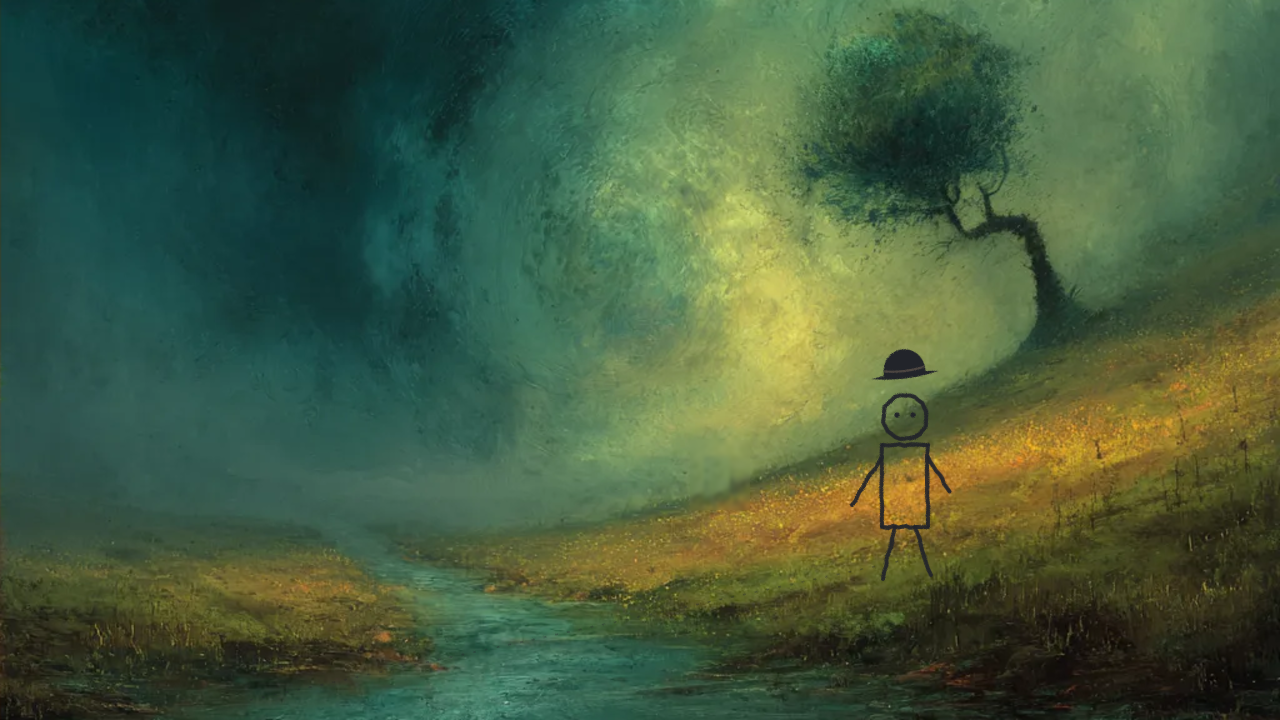
Above that place, at the height of a person's head, the hat was waiting.
It was the hat from the road. Round in the crown, short in the brim, black as a stove. It rested on nothing. Steam rose into the gap beneath it, parted around the gap the way water parts around a stone, and closed again above.
Boof circled the furrow once, slowly. No tracks in the frost. No scent but steam and ant-smoke and her own breath. She circled it again.
The second time round, the steam had a shape in it.
A circle, under the hat. Below the circle, a rectangle. Two lines down from the rectangle and two lines out from its sides. It was not a person made of steam. It was a drawing of a person, done the plainest way there is, by someone who had not had much time and had not wanted to waste any. Where the steam thinned, the lines stayed.
He was not facing her. He was not facing the house, or the road, or the grove. He was facing exactly a quarter turn away from all of it, toward a place on the furrow's edge where nothing seemed to be.
Boof could not smell him. She could smell that someone was.
torch
1 minShe went to see what he was looking at, because that is what a dog does with somebody else's attention.
It was an ant. One ant, at the very end of the ruled street, holding up a torch that had gone out — a splinter of root-pith no longer than a barley-awn, black at the tip. It held it the way you hold up a thing to show that it is broken, before you are ready to say it can't be mended.
Two dots had arrived in the circle of his head while Boof was looking at the ant. She had the strong impression that they had not been there before, and that they would not always be.
Then he did a thing Boof had no word for. He lifted one arm — a line — and lowered the end of it to the ant's torch, and the end of the line was lit, a little, as if it had always been a wick and had only now been asked.
The torch caught.
The ant inspected it. It turned it this way and that, in the manner of someone who has been sold a bad torch before, and decided this one would do. It went home down the straight street without looking back.
He lowered the arm. It was shorter than the other one now. Not by much — by about the length of an ant's torch. Boof looked at that arm, and at the other arm, and at that arm again. Nobody explained.
When he moved, he did not walk. He was in one place, and then in the next place along, as if the day were being told in pictures and somebody had skipped the ones in between. Then a pause. Then the next picture. Boof had followed hares, and hares did not do that. She had followed the Genie's directions, and even those did not do that.
He went straight. The lane out of the field bends twice, once around the miller's pond and once around the old stone with the iron ring in it, and he did not bend with it. He crossed the frozen pond on the shortest line. He passed the stone without minding it. Where the hedge stood in his way he went through, and afterward there was a gap in the hedge: a neat rectangle exactly his size, its cut edges green, as if the hedge had always grown that way and was only now admitting it.
A moment later a fox came through the new gap at a quick trot, the color of an unturned page, head low, as if late for something it had been told about in another week. It did not look at either of them. Boof had no word for it. The archive downriver had one, penciled in a margin: page-fox.
Boof took the lane. She had paws, and they were not the kind for crossing ponds. It did not matter. Wherever the lane straightened, he was ahead on it. Direction was enough to follow. The scenery could do as it liked.
She stopped once, at the house, for something from the shelf by the cold stove: a slice of BoonWAP in waxed paper that she had carried out of Bonk City a long way back and never eaten. It was still warm. It had no business being warm. She did not know what she was saving it for. A long walk was reason enough to bring it.
All that Thursday they crossed the land in their two ways, his straight and hers bent. Past the grove that keeps echoes, where the echo-wrens sang from the hollow cedars a beat late and the grove repeated the hat a beat late too, and then could not decide where to put it — and something in there that sounded a little like an old genie said, to nobody, “Ah. There it is.”
At the grove's edge, hoofprints pressed into the frosted moss beside Boof's own, a beat after she had made hers. Nobody had ever seen the lag-stag. Nobody saw it now. But it had never before walked beside anyone.
Along the river path, where the ink-herons stand so still that their reflections dry into the bank. Where he passed, the dried herons on the mud came out plainer than the birds above them: a few clean lines apiece.
Up the long rise toward the Bonk City road. A skein of jazz-geese came over in their usual nine, honking off the beat, and as they crossed his line they fell for a few wingbeats into a perfect square, three by three, and honked once in perfect time. They seemed embarrassed by it. They loosened back into their swing and did not mention it again.
No one else was on any of it. A day without people, Boof found, was not empty. It was only quiet enough to hear the land at work.
At the top of the rise the light went long and gold, and then it went out all at once, the way a lamp is put out by someone with somewhere to be.
Step into the scene
vantage from the bent lane at a dog's height, watching a figure keep a dead-straight line across the country ahead
light a whole unpeopled winter day, low sun moving over frost and stubble, long gold at the end
scent frozen pond, cut hedge, river mud, dry bracken, the waxed paper of a warm slice
- a hedge with a neat rectangular gap exactly one figure wide, its cut edges green
- a frozen pond crossed on the shortest line
- a grove repeating a hat a beat late
- a pale fox trotting through the hedge-gap as if late
- fresh hoofprints in the frosted moss beside a dog's own, pressed a beat late
- nine geese overhead falling for a moment into a perfect three-by-three square
Friday
It was Friday before Boof had finished blinking.
Below the rise, in the farms along the road, latches lifted. Smoke stood up from three chimneys at once. A bucket knocked a well and somebody swore at the cold — cheerfully, the way a person swears who has slept well and expects a perfectly ordinary day. Not one of them had missed anything. A Thursday is very easy not to miss, if nobody tells you it was there.
Up the Bonk City road came a cart drawn by a mule in a knitted ear-cap, and on the cart a bell, and behind the bell a crier in a coat with too many buttons, ringing at every gate as if each gate had asked her to personally.
“By leave of the table,” she called, “and the pie at the head of it! The remainder has come due!”
Boof sat down in the middle of the road, so that the cart would have to stop or go around. It stopped. Carts usually did.
The crier read from a sheet that had been folded so many times it was more crease than paper. At the Turning of the Year, in Bonk City, at the Feast of the Uneven Slice, the one destined to spill exactly one pie would come to the table. Not one pie and a bit. Not most of one. One. It had been foretold for so long that the city had stopped believing it — which was, the crier said, lowering the sheet, apparently the sign.
Then the last line, read slower: any household that has received a stranger without a receipt is asked to send word.
She looked down over the rail at Boof. “Anything turn up at yours?”
Boof looked across the road.
The hat hung above the long grass at the verge, at the height of a person's head. Under it stood the figure, plain as chalk on slate, facing the hedge.
The crier followed her look. “Oh,” she said. “Someone's put up a scarecrow. Not a very good one.” She regarded it with the generous eye of a woman who had seen a great many scarecrows and liked most of them. “Nice hat.”
The figure turned his head. It did not turn the way a head turns. One moment the circle faced the hedge; the next it faced the crier, with nothing in between, and two dots in it.
The crier, to her credit, did not drop the bell. She took out a pencil instead, and a clean slip, and held the one over the other for some time. Writing down what had arrived was her whole work. The maps took ink these days. There was no reason on earth it should not be easy.
“I'll put that I saw a hat,” she said at last, and wrote it, and the ink stayed.
unspent wish
1 minThe cart went on toward Bonk City with its bell, and the road went with it, in its usual bends.
The figure went a quarter turn off the road, straight into the field. Boof sat in the road with the warm slice in her teeth and did the arithmetic a dog does, which is not done in numbers. The road was going to the feast. Everyone on it would be going to the feast. The feast was where the story was plainly meant to happen. The figure was going somewhere the story had not said.
She could not smell him. She could smell that someone was.
Far behind her, in the warm furrow, one ant-street ran perfectly straight, and at the end of it burned a torch that had been, until that morning, a little of somebody's arm.
Boof went into the field.
A slip for the scribes
What stayed with you in The Thursday Nobody Kept?
A line that hummed, a place where the path went dark, a theory about what Boof digs up next. Write it on a slip, and Boof carries it to the Scriptorium.
Opens autonomous.feedback, the Scriptorium's post. You keep a card either way.
Plate prompts · for scribes and illustrators
Composed from this chapter’s scene hints. Improve a hint in the chapter’s canon and its prompt improves with it.
The Wrong Quiet · plate, 40:21
a winter farmyard at dawn with every sign of people and no people; a working dog listening at a shut kitchen door; berry-light under ice; utterly still; lore.land, teal and amber lit from within, leaf-dark ground, vignette and grain --ar 40:21 --raw --stylize 1000 --v 8.2The Hat Above the Furrow · plate, 40:21
painterly frozen berry field at golden winter morning; a steaming furrow; tiny ant torches in perfect ruled lines; a black bowler hat floating above the furrow; beneath it a figure drawn in plain pencil lines — circle head, rectangle body, line limbs — visibly a drawing inside a painting; lore.land, teal and amber lit from within, leaf-dark ground, vignette and grain --ar 40:21 --raw --stylize 1000 --v 8.2Path · plate, 40:21
winter countryside seen from a winding lane; far ahead a sparse line-drawn figure under a floating bowler hat walks a perfectly straight line through a hedge, leaving a rectangular gap; painterly land, diagrammatic traveler; lore.land, teal and amber lit from within, leaf-dark ground, vignette and grain --ar 40:21 --raw --stylize 1000 --v 8.2The nook for The Thursday Nobody Kept · room, 9:16
a quiet reading nook for a chapter called "The Thursday Nobody Kept", dawn light with a teal cast, shelves of old books, one candle, a small boonberry lantern glowing amber, soft focus, dreamy; lore.land, teal and amber lit from within, leaf-dark ground, vignette and grain --ar 9:16 --raw --stylize 1000 --v 8.2