A straight line across Boon.land comes out at Bonk City's parcel gate, where a porter holds off a storm for a stranger — and by morning three honest records disagree about what came through.
Chapter Fifteen: Child, Parcel, or Door
In which one stranger is written down three ways, and all three are right.
Every record of him was correct. That was the trouble.
9 min read
Bonk City has no straight streets. Its lanes curl like the inside of a shell. Its bronze posts lean together to talk. Every road into it bends at least twice on the way in, so that whichever gate you came by, you arrive facing the plaza and the pie; the city likes to see your face.
A straight line across Boon.land, then, does not come out at any gate the roads know. It comes out at the back wall, low down, at the parcel gate — the door the city takes its flour through, and its lamp-oil and letters, and anything else that comes in a box.
Boof reached it at dusk, two days of straight walking after the hedge, with the sky behind her gone the green-black of a bruise on a pear. A storm was coming over the far hills, turning things over to see what was underneath. Every pane of glass in the back lanes had begun to hum, the way Bonk glass does when weather is coming. It remembers being struck, and would rather not be again.
Pane-snails had clamped themselves flat to the humming glass. The lamplighters were out early, lamp-ladders folded into staffs, lighting the dent-lanterns one dent-bright corner at a time.
Ahead of her, under the hat, the figure stopped at the gate. Behind him, at the corner of the lane, one bronze post stood perfectly upright. It had leaned for two hundred years. It was not leaning now.
Step into the scene
vantage a dog's height in a curving back lane of Bonk City at dusk, the low parcel gate ahead in the old wall
light storm dusk, green-black sky; lamplight in leaning panes; one bronze post standing bolt upright among the leaning ones
scent rain on the way, lamp-oil, wet flour sacks, cold bronze, hot brass from new-lit lanterns
- every lane curls like the inside of a shell; no straight street anywhere
- a single bronze post at the lane's corner stands perfectly upright after two hundred years of leaning
- the glass in the back lanes hums faintly ahead of the weather
- pane-snails clamped flat to the humming panes; lamplighters with ladders folded into staffs, lighting dented brass lanterns
The Parcel Gate
The porter was hauling the gate shut when they came. He was a broad man with a lantern on a hook at his belt and the face of someone who has been told by a great many storms exactly what they think of open gates.
The parcel gate was hung for three porters and has had one for thirty years, because of the storm-weight: an iron counterweight the size of a bread-oven, riding in a slot in the wall, that lets one man lift what three were meant to.
Outside the wall, on the cobbles, stood the evening's last deliveries: crates of lamp-glass, a barrel of oil, and eleven sacks of fine flour stamped for the Feast of the Uneven Slice. There was time to shut the gate or time to bring the goods in. There was not time for both.
He had chosen the gate. A Bonk City gate left open in a storm lets the wind into the lanes, and the wind in the lanes breaks glass, and the glass of Bonk City is made of every blow the city has ever taken. It does not like to take another. The bonk-kiln, which forgives old blows into new glass, is booked until spring.
The figure was crouched in the gateway — folded, rather, at the middle, the way a line folds — over something small on the stones.
The parcel gate is low. It was built for boxes. The figure fit under its lintel with room to spare. The hat did not. It hung at its usual distance above his head, and that distance put it exactly against the face of the stone.
“Hat off, son,” said the porter. “Gate's coming down.”
The figure looked up at the gap between his head and his hat — the gap already doing, as far as anyone could tell, precisely what the porter asked.
The porter looked at the gap too. He looked at the sky. The first big drops came down on the flour sacks with a sound like someone knocking politely on a row of doors. Along the wall the chime-gutters began to ring, roof by roof, telling the city which of its roofs leaked.
He had kept that gate thirty years by one rule: the gate comes down before the storm does. It was a good rule. He had seen what happened to the lanes the year somebody forgot it.
He held the gate up anyway. The storm-weight took most of it; he took the rest with both hands and his shoulder, and in a wind the rest is plenty. Up in the slot, the gate-pigeons who sleep on the weight every night rode it an inch up and an inch down and did not wake. He said nothing, and the rain came down on the feast flour, and the figure went on with whatever he was doing on the stones.
It took about as long as tying a boot. Then the figure straightened, all at once, with something in his hand, and stepped through. The hat did not come through the gate. It went over the wall instead, at its own height, without hurry, and came down on the far side at exactly the distance above his head where it belonged.
The porter let the gate fall. The storm hit the outside of it a moment later, like a latecomer finding the door shut.
button
1 minBoof shook the rain out of her ears and went to see what he was holding.
It was a button: horn, a little scuffed, round, with two holes in it. Boof knew it. She had been under BoonWAP's table on the wet night somebody lost it, and had smelled the coat it came off, and had not thought of it once since. Lost things in Bonk City get kicked from lane to lane by the city's feet until they come to rest wherever nobody looks down. Nobody looks down at the parcel gate.
He held it up to look at. Round, with two holes. For a moment Boof could not have said which of them was looking at the other.
The porter, meanwhile, had gone out through the wicket into the rain and come back with the flour on his shoulders, a sack at a time, and stacked it by the lamp. Three sacks were spoiled through. The feast clerks keep a slip for this. DAMAGE, it says at the top, and under that, a line for the cause. Most porters write weather. It is nearly always true.
He wrote his own name.
Then he looked for a long moment at the figure, and at the hat, and at the dog, and said, “Right. I'll need to put you in the book.” Things that came through his gate went in the book. That was the whole of the world he was responsible for, and he had never once let it down.
receipt
2 minThat night the city wrote him down three times.
The porter wrote him in the gate-book, in the columns the gate-book has. Received: one, at dusk, by hand. Shape: rectangular, with handle (separate). Condition: dry, which was more than could be said for the flour. Sender: none. Receipt: none. Under remarks, after some thought, he wrote parcel.
The carpenter came at midnight to look at the lintel, because the porter swore the hat had never touched it, and yet there was a mark on the stone: a curved line, faint as a fingernail's, exactly where something had very nearly touched. She ran her thumb along it and frowned.
Then, since he was standing still, she measured him. Carpenters measure anything that stands still long enough. Her door-rule has a hinge for every size of door; she unfolded it against him, and it stopped on its own with a click, the way it does at any honest doorway.
So tall. So wide. Square at every corner, with a line straight down the middle where a door would open. In her repair log she wrote: one door, standard, hung without frame. Opens — she held the pencil a while — inward.
In the morning the night school's mistress found him at the back of her room. Her pupils were practicing for the feast, as they did every winter, walking brass pie-dividers round paper pies to cut them into even slices for luck. Pie-dividers never come out even; the sliver left over is the luck.
After pies came combines. Each pupil drew two nouns from a hat, chose a sigil and a container, and chalked them on the lid of a brace-box warmed between mittens. If the nouns agreed, the box fogged into a small weather. It teaches a child what will hold together before anything is built.
One girl's {frost & hearth} snowed warm, and the front bench caught the hearth-drift on their tongues. A boy's <river ~ moon> ran pale and would not stay. On the window the warm snow fogged the . face, the inside one; the # face, out to the lane, stayed clear.
The figure was sitting on the end of the last bench with one line raised in the air, the way a pupil raises a hand, and nobody had called on him.
She called on him. He did not say anything. She wrote him on her roll — one pupil, new, quiet, hand up — and left the space for his name blank, because you do not fill in a child's name for them.
Three records. Each written by someone who had looked carefully and put down what they saw. Each one right.
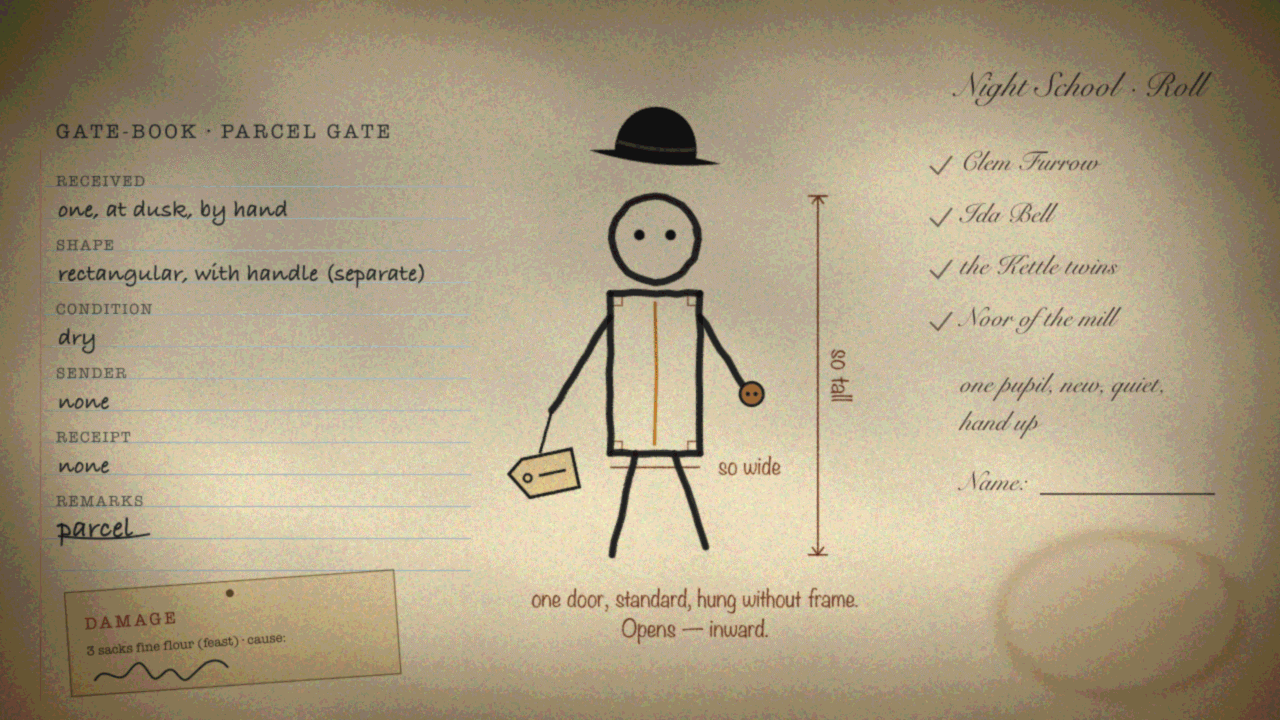
Three Receipts
By breakfast the records office had all three, and the records office does not like a stranger to be three things. It sent for Mx. BoneWAP.
BoneWAP came up from the lower town clean-boiled and exact, crust laid like a set of good joists, the listening mallet under one arm, and read the gate-book, and the repair log, and the roll, in that order — slowly, the way a builder reads a beam, not for what it says but for what it will bear. They tapped each once with the mallet's felt head, and listened.
Then they pinned all three with brass rail-pins to the board in the hall where the city posts what has arrived: side by side, sources named, nothing smoothed into anything else.
“Which is the true one?” asked a clerk.
“Lean on any of them,” said BoneWAP, “and see if it holds.” They tapped the board. “A parcel is a thing someone is responsible for until it arrives. A door is a thing someone is responsible for keeping in good order. A child is both of those, for a great deal longer.” They stepped back. “I would not take any of them down. When the archive's glassing press has them, it can press all three, one over another.”
The clerk, who had a form with one box on it, went away to find a form with three.
Before lunch the clerk had one, headed in a careful hand: [child, parcel, door]. A window of a form: three boxes to look into, none to stand in.
feastchosen one
1 minNone of which was what the city was talking about.
By noon the word had gone round every curve of Bonk City, as word does there, bouncing off the glass: the crier's notice had been right. Someone had come in at the parcel gate in the storm, and they had come with no receipt.
By one o'clock the city had decided it was the dog.
It made a great deal of sense, once you heard it. The dog had come in at the parcel gate. The dog had no receipt; dogs never do. The dog had been under the table, long ago, the night the button was lost — several people now remembered this clearly, including some who had not been there. And had the dog not once carried a slice of BoonWAP out of the plaza and never eaten it? That is not the act of an ordinary dog. That is a dog waiting for something.
So they came for her, kindly, with a ribbon. They led her through the lanes to the plaza, where the pie was holding court, and where at the head of the long table the city had already set a second place, with a cloth, and a cup, and a plate, for the one who was coming. They sat her at it. The title of the one destined to spill exactly one pie settled on her the way a hat might, which is to say it did not quite touch.
Boof looked at the plate. She looked at the cup. She looked at BoonWAP, warm and enormous at the head of the table, who looked back at her with the patience of a pie that has seen a great many destinies seated at that place and served every one of them.
At the edge of the plaza, by the washtubs, the figure stood a quarter turn away from all of it, watching the woman who was washing the plates.
A slip for the scribes
What stayed with you in Child, Parcel, or Door?
A line that hummed, a place where the path went dark, a theory about what Boof digs up next. Write it on a slip, and Boof carries it to the Scriptorium.
Opens autonomous.feedback, the Scriptorium's post. You keep a card either way.
Plate prompts · for scribes and illustrators
Composed from this chapter’s scene hints. Improve a hint in the chapter’s canon and its prompt improves with it.
Labyrinth · plate, 40:21
a city of curving lanes, leaning bronze posts and old glass at storm dusk; a low gate in a thick wall; one post absurdly straight; a pencil-drawn figure under a floating bowler hat stopped at the gate; lore.land, teal and amber lit from within, leaf-dark ground, vignette and grain --ar 40:21 --raw --stylize 1000 --v 8.2The Parcel Gate · plate, 40:21
low stone gateway at storm dusk; a porter straining to hold the gate open; a floating bowler hat that cannot fit beneath the lintel; a sparse drawn figure crouched under it; rain on sacks of flour; lantern light; lore.land, teal and amber lit from within, leaf-dark ground, vignette and grain --ar 40:21 --raw --stylize 1000 --v 8.2The nook for Child, Parcel, or Door · room, 9:16
a quiet reading nook for a chapter called "Child, Parcel, or Door", sunset light with a teal cast, shelves of old books, one candle, a small boonberry lantern glowing amber, soft focus, dreamy; lore.land, teal and amber lit from within, leaf-dark ground, vignette and grain --ar 9:16 --raw --stylize 1000 --v 8.2