Two claims pull at one warm egg until the floor itself parts — and the crack beneath the hall is still singing the price of a grand wish granted centuries ago.
Chapter Five: The Quiet Rift
In which two slips try to be one harvest.
Silence is not empty. It is two wants holding the same breath.
5 min read
eggbane wish
1 minThe hall under the tall stone arches was calm the way a drawn bowstring is calm. Sunlight lay across cedar shelves and a long desk worn pale by elbows, and across the slate floor ran a hairline crack that hummed. Boof padded in on quiet paws, following the vibration before she could hear it — the
It was not only the crack that hummed. Down in the dark of it lived the hum-crickets, chalk-pale and no longer than a barleycorn, and they kept its pitch the way a choir keeps a note for a singer who has stepped out. The clerks fed them seed-cake crumbs at elevenses and crossed the floor in felt hush-slippers. A cricket that went silent, they said, meant somebody near the floor was lying.
Two slips hung over the desk, pinned with silver bodkins, and both of them were pulling. One was the boon-claim: the wish belongs to whoever found it, and through her to everyone. The other had arrived at first light in Mr. BaneWAP's crust-brown envelope, sealed twice and smelling faintly of sour pastry: the wish is a thing, and things belong to whoever can hold them longest.
Each slip leaned toward the egg in Boof's sling. The egg leaned toward neither. Below the desk its warmth found the hairline, and the floor began, very quietly, to part.
Boof lay down beside the crack to hear it better, chin on the cold slate. Every cricket in the hall stopped at once. So did the pens. Three clerks found themselves looking very hard at a dog. Boof looked back, owl-quiet. She had only lain down.
The Genie did not turn from the window. “Lying has two meanings,” he said. “Nobody has ever told the crickets which.” Boof stood. The hum came back as if it had never left.
Under the hum, the silence in the room was not peaceful. It was the silence of two wants holding the same breath, kept only because nobody had dared to let it go.
Step into the scene
vantage on a counting-room stool's crossbar, chin at cedar desk height, where the vellum spread fills the field of view
light wide calm afternoon sunlight through clean arched windows; on the sunlit page, one hairline of pure dark that light refuses to cross
scent ink dust, linseed floor wax, cold tea gone glassy in a porcelain cup, stone kept excessively quiet, seed-cake crumbs
- the master ledger lies open to a spread balanced to the penny, except for the hairline fracture
- the crack runs off the vellum, across the desk grain, down the carved leg, and into the slate floor
- two claim-slips hang pinned above the split — one smelling of shared kitchens, one of a shut vault
- the Genie stands at the window with his back to the room, listening to the floor
- chalk-pale hum-crickets at the lip of the crack, keeping its pitch
- felt hush-slippers in a row by the door
The song climbed the rafters by a narrow stair of notes. One rose for a wish shared out; one held for a wish locked away. Together they made a sound Boof could feel in her teeth, and down in the crack the crickets took the lower note and held it, patient as hens on a cold clutch.
She shifted her paw. The crack ran on beneath it, under a pounce-pot and a dropped quill. Whatever the slips said, the floor could not keep both promises.
Step into the scene
vantage inches from the open ledger, watching the silver bodkins vibrate
light amber lamplight casting long dual shadows from the two pinned slips
scent iron gall ink, old dried sheepskin, brass filings
- the boon-claim is stamped with the seal of the communal winter kitchens
- the bane-claim is stamped with a private vault seal, twice
- the vellum fibers around the crack shiver in harmonic resonance
two receipts
1 minTwo receipts on one warmth — the oldest quarrel on the shelf. Somebody wished big here once, and the floor is still paying the note.
The tuning fork hummed against the split desk. The wood, not the Fool, was singing — a very old melody, in a key nobody had budgeted for. Dust stood still in the light to listen.
Step into the scene
vantage looking up at the tall clerk's high-backed chair where the Fool sits cross-legged
light afternoon dust motes swirling around the Fool's raised silver tuning fork
scent cinnamon, old ledger glue, dry paper shavings
- the Fool holds a tuning fork against the edge of the split desk
- his patchwork boots rest on the bottom shelf of tax rolls
- his smile is solemn, listening to the pitch of the wood
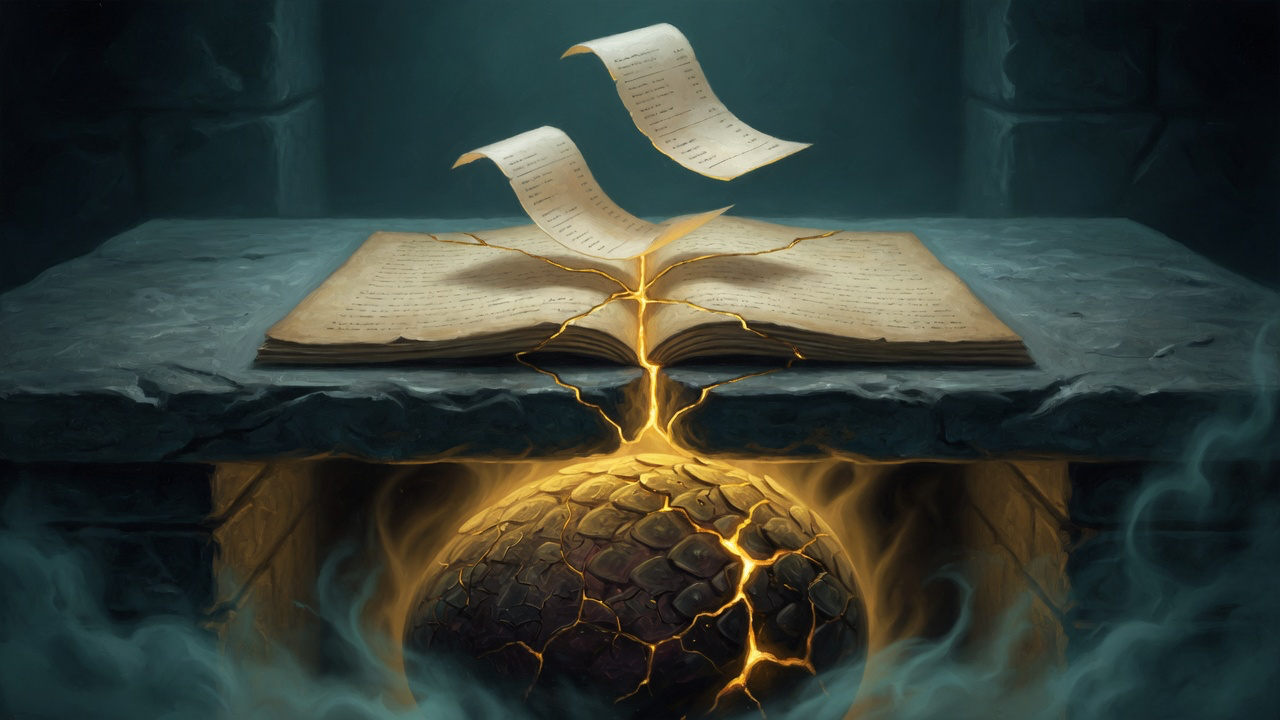
Wish-Physics Over the Crack
Where the crack left the desk leg for the floor, the clerks had set the crack-gauge: brass calipers as long as a forearm, one jaw on each lip of slate, a small bell at the hinge. It measured in notes, not inches. Every morning the oldest clerk took the note with a fingernail and wrote it in the margin. F at the thaw. F sharp by lambing. When Boof's tail brushed the calipers, the bell gave a note nobody had written yet.
The youngest clerk had the wax pot open before the bell had stopped. The oldest put two fingers on her wrist. “Listen before you mend,” he said. It had been the floor's rule since the winter a mason poured lead into the crack without taking its note, and the slate went on singing through the lead all spring, a tone lower and sulking, until they chipped it out. He wrote the new note in the margin first. Then he shut the wax pot himself.
The Genie stood astride the crack. “A cart rolling. Rain falling. A Thursday on its way. A wish can turn those.” He nudged a loose edge of slate. “Ask for a little turn, pay a little. Ask the world to swing around you, and somebody else catches the weight.”
He bent to the gauge and read it the way he read a price tag. “There's the interest,” he said. “In semitones.” Long ago, someone had wished grandly here. Gold, perhaps. A throne. Nobody remembered the wish. The crack remembered its weight. “Still paying,” he said. Under his slipper, the note went on.
The egg did not pick a side. A wish keeps its own law; it is not there to settle other people's wanting. Its heat kept the hairline open and honest, so no one could smooth the seam over with wax and a confident voice and call the quarrel finished. The crickets edged up the crack to sit near it, the way old men edge their chairs toward a stove.
Boof left both slips where they hung, pulling at nothing, and turned toward the duskward gate — toward the city that had learned to turn its old breakages into light. A little dried ink clung to the edge of the desk.
Boof watched it quiver when the note rose, then rest when it fell. The room had been swept with care. Pens lay straight; the stools were tucked away; whoever worked here had tried to leave things ready for morning. Yet the crack ran beneath all that order, passing under the stool where someone would sit and between the shelves where someone would reach.
On the window sill lay a carpenter's door-rule, boxwood and brass, folded shut on a size that matched no door in the hall. Nobody claimed it. It had the look of a thing set down mid-measure.
She could follow the crack farther than she could see. Somewhere beyond the wall, a cup began to rattle.
Boof understood the physics better than the hall did, because she had lived it at bowl-height her whole life. A dog who works for the land knows you cannot wish a bowl full; you can only be standing under the bush when the fruit was already going to fall. Redirect, don't create. Her wants had always been small enough to afford. She had simply never known that was a kind of wealth.
She had begun, without meaning to, to keep a map. Not the archivist's kind, with roads in it. A map of what kept what: the ants kept the roots warm, the roots kept the berries, the berries kept a little light for whoever came; the grove kept the wants the town would not; the crickets kept the crack's note so it could be heard out. Nothing on it was owned. Everything on it was keeping something else. She did not know yet where the egg went. Her own nose went in the middle, since that was where she read it from.
At the archway she looked back once. The door stood ajar on a gold, still room, and from under its floor came the hum, a little higher than it had been that morning.
Out in the avenue, the thin song faded into footfall, wheel-rattle, evening trade: a knife-grinder's sparks, a chestnut drum, a coal cart backing into a lane with a great deal of advice. Boof kept the egg close. Ahead, Bonk City's windows caught the last light: old impacts melted into glass, a skyline of things that had been struck and still let someone see through.
Step into the scene
vantage trotting through the counting house archway into the cobblestone avenue leading toward Bonk City
light late afternoon shadows lengthening across the cobbles; the egg glowing warm gold in the sling
scent fresh air, distant street food, rain on bronze roofs ahead
- the counting house door remains ajar behind her
- the sound of the humming ledger fades into the busy noise of the avenue
- ahead, the skyline of Bonk City glints with glass lantern towers
- a knife-grinder's wheel throwing sparks at the avenue's edge
The chapter in SpwWhat it is made of, and what you have found of it0 of 14 found
^chapter[5]{
  .rooms[ ={arched_hall}@boof ^<note_stair>@the_song {{CHAPTER_BODY}}lt;split_desk>@the_floor
    %{crack_gauge}@genie ^<archway>@boof ]
  @told_by[boof song fool narrator]
  $ink $brass $glass
  *wonders{ ?room_1 ?room_4 ?room_4 }
  =palette[rift]
  ~berries{ $boneberry[mushroom_broth] }
  &harmonies[ <crickets egg> <egg boof> ]
}.rooms- Five rooms: three < > passages and two { } rooms; two kept by Boof, the rest by the song, the floor and the Genie.
@told_by- Told by Boof, a song, the Fool and the narrator.
$- Made most of ink and line, then brass and bronze, then Bonk glass.
*wonders- Three wonders are first met here; look in rooms 1 and 4.
=palette- Its palette is the rift, earned a layer at a time: deep teal water and two slips of brass: two harvests trying to be one.
~berries- A boneberry in this chapter tastes of mushroom broth.
&harmonies- The crickets keep the crack's note, and sit near the warmth. The egg rides against her ribs.
Every expression the chapter holds, by its sigil. What you have found is lit, and takes you to where it lives; the rest say where to look.
potentialwhat lasts, or might0 of 1
~ ?A foreshadowing, marked in room 1.Look in room 1
perspectivewhose eyes0 of 1
@ ?A small chorus that lives in a crack.Look in room 1
confluencewhat meets and stays itself0 of 1
& ?A trope, marked in room 3.Look in room 3
integrationwhat binds upward0 of 2
^<note_stair>@the_songRoom 2 of 5: read it to its end.Look in room 2^<archway>@boofRoom 5 of 5: read it to its end.Look in room 5
annotationwhat is said, or marked0 of 3
# ?A motif, marked in room 1.Look in room 1# ?A motif, marked in room 4.Look in room 4# ?A rule the clerks keep about the floor.Look in room 4
configa lean, a way chosen0 of 2
={arched_hall}@boofRoom 1 of 5: read it to its end.Look in room 1= ?Read the chapter to its end, and its first colour is yours.
measurehow much0 of 1
%{crack_gauge}@genieRoom 4 of 5: read it to its end.Look in room 4
substratewhat it is made of0 of 3
{{CHAPTER_BODY}}lt;split_desk>@the_floorRoom 3 of 5: read it to its end.Look in room 3$ ?Calipers that measure a sound.Look in room 4$ ?A rule that folds to fit any door.Look in room 4
At the tablePlay in this chapter
The hall of arches below Council Hill: cedar shelves, a long desk worn pale by elbows, clean arched windows, and across the slate floor a hairline crack that hums. Clerks cross it in felt hush-slippers; two claim-slips hang over the desk on silver bodkins, both pulling; brass calipers straddle the crack with a small bell at the hinge, and the ledger margin keeps a column of notes. It smells of ink dust, linseed wax, cold tea gone glassy and seed-cake crumbs, and through the door comes the evening trade of the avenue to Bonk City.
Light Wide, calm afternoon light that will not cross one dark hairline on the floor, with a faint gold down inside the crack. By lamplight the two pinned slips throw doubled shadows across the desk, and the gold in the crack is the brightest thing in the room.
People
- the oldest clerk of the hall wants to take the crack's note every morning before anything is touched, and to keep the margin true — A fingernail on the bell; speaks in pitches; two fingers on your wrist if you reach for the wax.
- the youngest clerk wants to mend something, anything, today — Sleeves rolled, wax pot always open; quick, kind, and learning to wait.
- the hum-crickets wants elevenses at the crack's lip, and nobody lying near the floor — A chalk-pale choir holding the lower note. They fall silent all at once and never say which kind of lying they meant.
- the Off-Season Genie wants to stand at the window and not be involved — Reads the gauge like a price tag, in semitones, and reminds you that lying has two meanings.
Hooks
- The leaded floor. In a counting house across the avenue, someone once mended a singing crack without taking its note, and the floor has sung on underneath ever since, a tone lower and sulking; now every cup on the street rattles at night. Listen before you mend: find the note it sang before the lead, before anyone lifts a chisel.
- A silence at noon. Every cricket in the hall went quiet at once this morning, and nobody was lying down. Somebody near the floor is lying — or lying in some way the crickets have never been told about. The clerks want to know which before tomorrow's note is taken.
- The rule on the sill. A carpenter's door-rule lies on the window sill, folded shut on a size that matches no door in the hall. Unfold it hinge by hinge and go looking for the door it was measuring — a cellar, a bread-oven, a dovecote, a vestry — and find every one wrong by a hair. Whoever set it down mid-measure has not come back for it, and the rule will not say whose it is.
Roll a d6
- A tail, a hem or a boot brushes the crack-gauge and the bell gives a note nobody has written yet. The oldest clerk wants it in the margin before anyone moves.
- Someone lies down on the cold slate to hear the floor better, and every cricket stops. Three clerks look very hard at them.
- Elevenses: seed-cake crumbs at the crack's lip. The crickets edge up to eat, and the room's note dips a hair while they chew.
- Beyond the wall a cup begins to rattle, then a spoon in its saucer, then a row of jars: the crack runs farther than anyone can see.
- A runner arrives with a crust-brown envelope, sealed twice and smelling of sour pastry. Over the desk, the silver bodkins start to pull.
- Out in the avenue a coal cart backs into a lane with a great deal of advice, and its jolting sets the hall's note a semitone sharp until it has gone round the corner.
Worth carrying out
- Hum-crickets — Ask your question near the crack: if every cricket stops, someone near the floor is lying. The catch: lying has two meanings and nobody has ever told the crickets which, so sit down on the slate to rest and a whole choir will call you a liar.
- The crack-gauge — Set across any break — a floor, a beam, a friendship — it measures in notes, not inches, and the bell tells you how much is still owed. The catch: it gives you the interest, never the wish behind it, and once you have taken a note, somebody has to take it again every morning after.
- The door-rule — Unfold it hinge by hinge against a doorway and it stops with a click on an honest size. The catch: this one is folded shut on a size no door in the hall matches, nobody claims it, and it will not say whose it is.
A bracework move
[ledger @ cricket]Does A window on the account book as the crickets hear it: for a minute every entry sings at its own pitch, and anything still owing rings flat.
Costs It runs on the crack's own warmth. For a week the floor sings a semitone sharp, the oldest clerk needs an extra line in the margin every morning, and the crickets keep the lower note to themselves out of pique.
The page’s own dice
Every phrase in this chapter that breathes, as a table to roll on. The first face is the book’s own words.
d5 · turns by the day
- seed-cake crumbs
- oatcake crumbs
- crumbs of caraway bun
- parkin crumbs
- shortbread crumbs
d5 · turns by the hour
- a pounce-pot and a dropped quill
- a sand-shaker and a curl of string
- a pen-wiper and a lost button
- a blotter and a fallen stick of sealing wax
- a tea-tray and a spill of pencil shavings
d5 · turns by the minute
- a cup began to rattle
- a spoon began to chatter in its saucer
- a windowpane began to buzz
- a row of jars began to tick against each other
- a kettle lid began to tap
d5 · turns by the hour
- a coal cart backing into a lane with a great deal of advice
- a brewer's dray backing into a yard with a great deal of advice
- a hay wain turning in the street with a great deal of advice
- a barrow of slates going round a corner with everyone's help
- a carrier's van reversing up an alley to a chorus of opinions
Ask the table Somebody wished grandly over this floor once, and the crack is still paying the note. Nobody remembers the wish. What was it — and who, today, is still catching the weight?
A slip for the scribes
What stayed with you in The Quiet Rift?
A line that hummed, a place where the path went dark, a theory about what Boof digs up next. Write it on a slip, and Boof carries it to the Scriptorium.
Opens autonomous.feedback, the Scriptorium's post. You keep a card either way.
Plate prompts · for scribes and illustrators
Composed from this chapter’s scene hints. Improve a hint in the chapter’s canon and its prompt improves with it.
Boof · plate, 40:21
sunlit counting room from low at the desk edge; an open ledger with a single hairline crack of darkness running across page, desk, and wall; two pinned claim-slips fluttering without wind; a tall quiet figure at the window; warm paper tones split by one thin dark seam; lore.land, teal and amber lit from within, leaf-dark ground, vignette and grain --ar 40:21 --raw --stylize 1000 --v 8.2Song · plate, 40:21
macro close-up of two parchment claim-slips pinned over an open ledger split by a thin black hairline; vibrating silver pins catching gold lamplight; lore.land, teal and amber lit from within, leaf-dark ground, vignette and grain --ar 40:21 --raw --stylize 1000 --v 8.2The Fool · plate, 40:21
a jester figure sitting cross-legged in a tall leather counting-house chair, holding a humming tuning fork to a split wooden desk; lore.land, teal and amber lit from within, leaf-dark ground, vignette and grain --ar 40:21 --raw --stylize 1000 --v 8.2Wish-Physics Over the Crack · plate, 40:21
quiet counting room, hairline gold rift through stone and paper, two claim-slips that cannot both post, a coal-dark cracked egg warming the fracture from below while a tall figure lectures over the seam; lore.land, teal and amber lit from within, leaf-dark ground, vignette and grain --ar 40:21 --raw --stylize 1000 --v 8.2Boof · plate, 40:21
a working dog carrying a glowing egg emerging from an old stone doorway onto a wide paved road leading toward a city of gleaming glass lantern spires; lore.land, teal and amber lit from within, leaf-dark ground, vignette and grain --ar 40:21 --raw --stylize 1000 --v 8.2The nook for The Quiet Rift · room, 9:16
a quiet reading nook for a chapter called "The Quiet Rift", lamplight light with a archive cast, shelves of old books, one candle, a small boonberry lantern glowing amber, soft focus, dreamy; lore.land, teal and amber lit from within, leaf-dark ground, vignette and grain --ar 9:16 --raw --stylize 1000 --v 8.2