In a labyrinth of lantern-light, Mr. BoonWAP — a warm pie who serves himself and is never smaller — asks Boof the one question she cannot answer yet.
Chapter Six: Lanterns of Bonk City
In which glass shows a light it does not own.
A wish you can't say yet is still proofing.
7 min read
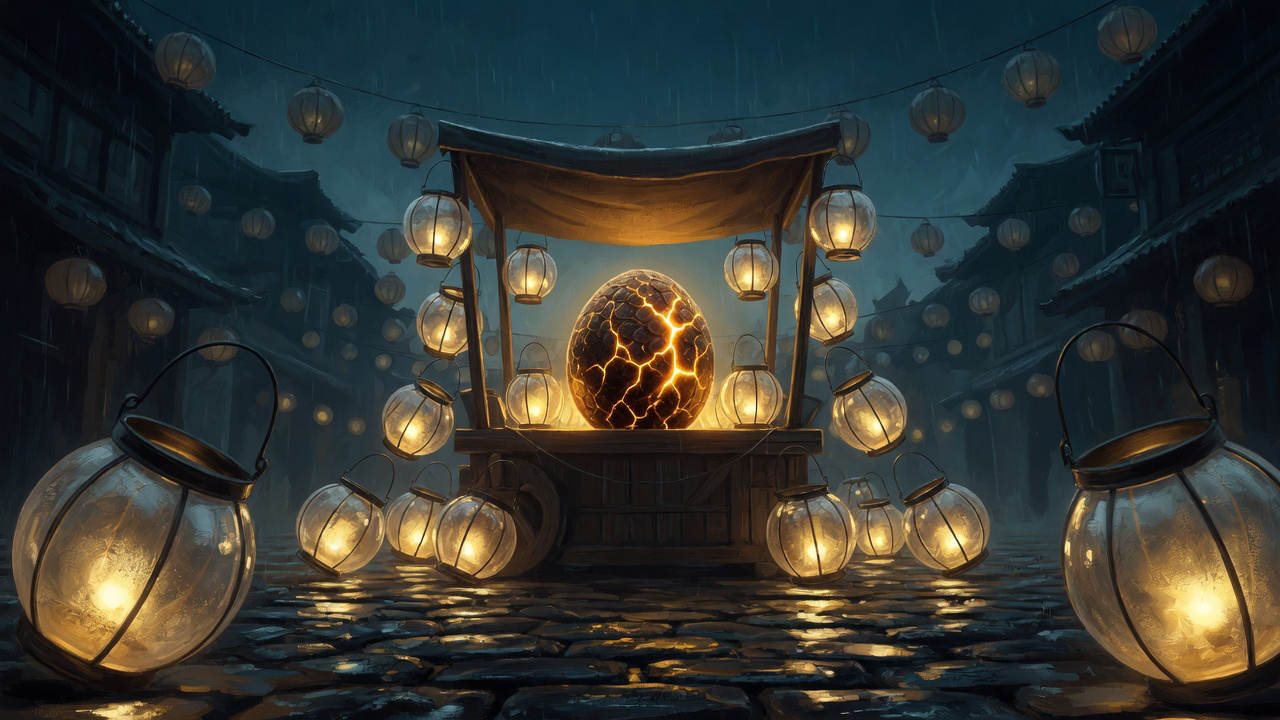
egg
2 minBoof trotted into Bonk City the way you step into the acoustic chamber of a struck bell. The streets did not follow straight surveyor lines; they formed a
The glass of Bonk City was not blown from river sand alone. It was made of old impacts. Anything struck — a dented kettle, a cart's bent rim, a bell cracked one frost-bitten morning — went to the bonk-kiln, which melted the blow out and poured it off clear. So the panes remembered being struck, and had forgiven it into transparency.
The kiln stood just inside the gate, breathing a smell like a hot coin. Its soot-furred keeper saw the gold crack in the egg's crown and lifted her tongs. “We take cracks,” she said kindly. Boof stepped wide. This crack was not hers to shut.
The lanterns were honest in the one way that mattered — they showed light without claiming to be it. Most were dent-lanterns, and every dent threw a bright crease on the cobbles: a street the light remembers. Some of those streets had since moved. Boof followed one round a bakery and came out where she began, smelling of bread.
Every one of them turned its faceted face toward the warm egg in her sling, casting its heat across the cobbles while owning not a single ember of the flame.
Then rain came, fine as flour, and the city rang. Its chime-gutters are tuned like a shelf of cups, and a sound roof rings bell-bright. Two lanes along, one rang flat. A roofer stopped mid-bite, said “Cobbler's, back corner,” and went off with the rest of his bun.
A lamplighter came down the lane, ringing each post alight with a small brass bell. At every post she shook her lamp-ladder out of its walking-staff shape in three clacks, climbed, rang, and folded it again. “Pie's that way,” she said. “Everything's that way, eventually.”
And ahead, down the widest winding street, the smell of boonberries baking rose over the rooftops like a second dusk — because the patron of Bonk City was holding court, and the patron of Bonk City is a pie.
Step into the scene
vantage at the curb of a crooked street-corner, shoulder leaning against a bronze lamp post that is warm where it was once dented
light deep blue dusk; every lantern along the winding alleys glows from a pane of old-impact glass; long gold reflections across wet stones
scent warm bronze, supper smoke, wet cobbles, lamp oil — and somewhere ahead, unmistakably, hot pie, hot iron from the kiln doors
- each lamp post carries its old collision like a civic signature, light pooling in the crease
- a municipal lamplighter taps not with a flame but with a small brass bell — one sharp ring, one golden flare
- the labyrinth of streets glows in a traced network of past impacts
- at the city gates behind her, one archway stays dark, and the dark has a lattice pattern
- the bonk-kiln's iron doors just inside the gate, breathing heat, a soot-furred keeper with tongs
- dent-lanterns throwing bright creases on the wet stones — streets the light remembers, some since moved
- chime-gutters ringing along the eaves in the rain; one rings flat
- a lamplighter folding her hinged lamp-ladder back into a walking staff
“Every pane will offer you your own warmth,” said a voice behind the glass. Boof turned. Three reflections turned with her.
“Very flattering. Very little supper.”
In the corner of every pane a glazier had etched two marks: # toward the street, . toward the room. The # face travels, glaziers say; it meets rain and strangers. The . face stays home. This whole alley had been hung backward, and every pane was busy staying, showing Boof herself instead of the way.
But pane-snails had been at the soot, grazing it off by night in slow silver loops, and where one had passed the glass was forgiven clear right through: no Boof, no warmth, only a wet step, a cat on a sill, a corner. Boof sniffed a trail, chalk and cold rain, and went the way it showed her.
At the corner she lifted her nose. Through the rain and brass came the smell of crust. “There you are,” said the voice. “Glass can show a flame. It can't bake a pie.”
Step into the scene
vantage standing in a narrow alley between two mirrored bay windows reflecting endless corridors of light
light endless recursive golden reflections bouncing between glass panes
scent rainwater, tallow candles, damp mortar, warm crust
- windows lean outward over the alleyway, nearly touching at the eaves
- each pane multiplies the egg's warm silhouette into a hundred false guides
- the true path is paved with cobblestones worn smooth by working paws, and it smells of pie
- silver pane-snail trails looping through the soot, clear windows among the reflections
- a # and a . etched in each pane's lower corner, the whole row hung . face out
labyrinth city
1 minA lantern is a bruise that learned to give directions.
From the top rung of the lamplighter’s lamp-ladder he tapped the brass bell into a crease, and the post remembered heat. Old impact, sampled; returned as light, with interest. That, he remarked to no one and everyone, is the whole city in one honk.
Step into the scene
vantage looking up at a lamplighter's ladder propped against a glowing bronze post
light golden light pouring down from the lamp crease onto the Fool's face
scent hot glass, brass polish, rain on woolen sleeves
- the Fool balances on the top rung with a small brass bell suspended by a cord
- he taps the bell against the post, sending ripples of amber light down the shaft
- below him, water swirls down an iron drain-grate
The Pie at the Table
Every street eventually arrived at a round plaza. At its center, on an oak table, a warm boonberry pie held court. Rain had followed them into the plaza in the folds of coats and the soles of shoes. It steamed from the porters' shoulders while they ate.
Before pie, the porters ate boneberries off a brazier at the plaza's rim, a paper cone each, the skins blistered black at the edges. In Bonk City they taste of burnt ends: smoke and crust and a dark sweetness that sticks to the paper. They grow on the kiln walls, where the forgiving heat comes through the brick all winter. Grown, not raised, said the brazier-man, handing Boof the last one in a cone a porter had counted wrong, and he said it the way glaziers say the glass forgives. Boof filed the smell beside the kiln's hot coin, where it belonged.
A stall between the chestnut drum and the umbrella-mender sold brace-boxes: small glass boxes with sigil-etched lids, each fogged with a weather nobody had planned. The stall-keeper wrote every lid before she sealed it, so a box could be checked, and refused, before it was made.
{frost & hearth} snowed warm flakes on a thumbnail of hearthstone. (cat & bath) held nothing at all. Boof stopped at [grove @ dog], where cedars no taller than barley turned, very slightly, to look at her. Then every box on the shelf brightened toward the egg.
[grove @ dog]“Only what both nouns agree on,” said the stall-keeper, “and they run on borrowed warmth. A week, if nobody holds them.” Boof stepped back and took her warmth with her. The ants at home would not have approved. They knew where warmth came from.
Boof settled where she could watch the table legs and the lanes between them, the dropped crumb, the swinging heel, a spoon rescued before it reached the stones. Above her, conversation passed with the plates. Somebody had lost a button; somebody knew a shortcut home; a porter grumbled that the parcel gate's storm-weight groaned on the way up.
At the table's end a porter's two children walked brass pie-dividers round a paper pie. It never came out even. There was always a sliver left, thin as a paring, and they argued over it like judges.
Between courses their father unrolled something on the table's edge for the younger one to see: a page pressed flat under a sheet of Bonk glass, thin as a leaf and warm from his coat. Under the glass a drawn hill, a drawn dog, a smear where rain had once got in before the glassing and been kept there, forgiven.
He turned it over. A second page lay glassed beneath, older, the same hill drawn smaller. Folios, he told the younger one: whenever the story changed you took one to the folio press, which glassed it flat and warm over the last, so nothing known was lost, only layered. Boof put her nose to the edge. It smelled of pressure and heat and, faintly, of the day it was made.
The younger one licked a thumb to rub the rain-smear out. “Glass over, never scrape,” said their father before it landed, the glaziers' first law, and the thumb went flat on the glass instead. It left a small print that smelled, to Boof, of boonberry. “Next time this goes under the press, so does that,” said the porter. “Then you're in it.” Across the table a glazier with lead under her nails nodded. “At the map-house they say first ink stays. Same law. Wetter town.”
The egg warmed her chest, the ovens warmed her face, and for a little while she could sit among people whose largest unanswered question was whether to have another slice.
The knife went in. A slice came out. The pie stayed whole.
Boof watched it happen eleven times. A lamplighter ate. A porter took seconds. A child who ought to have been asleep licked the plate. Boof checked beneath the table.
No second pie.
“People take it for a boast,” said the pie, to the table at large, though nobody had said a word. “Never smaller. It is only arithmetic, and I am very good at arithmetic.” A lamplighter nodded with her mouth full. The pie took this for agreement and beamed at the whole plaza, which is a long way to beam.
A server set down another plate and rubbed her wrist. “Enough for everyone,” she told Boof. “Always.” She looked at the washing-up.
Boof got off the stool. The server sat.
Steam rose from the crust. The pie considered the egg. “If you spent the wish tonight, what would you ask?”
Boof opened her mouth. A furrow. A door. The smell of next spring. She could feel the want, but couldn't get its pieces into words. She shut her mouth again.
“Good,” said the pie. “Still proofing.” At the far gate, something lattice-crusted shifted in the dark. “Take it out too soon,” he added, more quietly, “and see what you get.”
berry memorybane wish
1 minBoof paused at the last curb of the labyrinth and shook the rain from her ears. She carried a slice of BoonWAP wrapped in waxed paper, and the pie behind her was exactly as large as before, and her wish was still wordless and rising somewhere behind her ribs, and all of that was, apparently, correct.
She had not eaten the slice. It was warm through the paper, and she was saving it. She could not have said for what. The glass had shown her light without claiming it. The pie had fed a plaza without shrinking. There were ways of being warm in this world that did not require owning the heat.
Over the back wall, where no street went, a pair of gate-pigeons rose slowly into the lamplight, fast asleep, hung there a moment, and sank out of sight.
She stepped past the last glowing pane into the quiet square. Under the open stars waited an ancient stone slab with a deep circular groove carved into its granite top: the place where oaths are given in public and paid in the honest currency of fruit. The wheel-tracks in the dew ahead of her smelled of hoarded berries. BaneWAP had left the gates before her, and he had come this way.
Step into the scene
vantage leaving the lantern labyrinth through an iron gate opening onto the open market square
light the glare of a hundred lanterns falls away; ahead, a single ancient stone rests under the moonlight
scent fresh mountain air, crushed blueberries, wet granite, night wind
- the lantern city glows behind like a clustered hive of gold sparks
- ahead, the oath stone sits in the center of an empty square
- a second set of wheel-tracks, bitter-smelling, already marks the road she is taking
- over the city's back wall, two sleeping gate-pigeons rising and sinking
The chapter in SpwWhat it is made of, and what you have found of it0 of 31 found
^chapter[6]{
  .rooms[ ${kiln_gate}@boof .<mirrored_alley>@the_labyrinth ^<lamp_ladder>@the_fool ?(round_plaza)@boonwap
    ~<iron_gate>@boof ]
  @told_by[boof labyrinth fool narrator]
  $glass $steam $brass
  *wonders{ ?room_1 ?room_1 ?room_1 ?room_1 ?room_2 ?room_2 ?room_4 ?room_4 ?room_4 ?room_5 }
  &met[?room_5]
  =palette[kiln]
  ~berries{ boonberry $boneberry[burnt_ends] }
  &harmonies[ <boonberries boonwap> <kilns glass> <kilns boneberries>
    <boneberries boof> <egg boof> ]
}.rooms- Five rooms: three < > passages, a { } room and a ( ) gathering; two kept by Boof, the rest by the labyrinth, the Fool and Mr. BoonWAP.
@told_by- Told by Boof, the labyrinth, the Fool and the narrator.
$- Made most of Bonk glass, then steam and warmth, then brass and bronze.
*wonders- Ten wonders are first met here; look in rooms 1, 2, 4 and 5.
&met- One is met here for the first time; look in room 5.
=palette- Its palette is the kiln, earned a layer at a time: purple and rust, where old knocks are forgiven into new glass.
~berries- Here boonberries foresee; a boneberry in this chapter tastes of burnt ends.
&harmonies- A boonberry pie is never smaller. The kiln forgives blows into glass. Boneberries grow on the warm kiln walls. A boneberry promises nothing, and feeds you. The egg rides against her ribs.
Every expression the chapter holds, by its sigil. What you have found is lit, and takes you to where it lives; the rest say where to look.
probewhat asks0 of 1
?(round_plaza)@boonwapRoom 4 of 5: read it to its end.Look in room 4
potentialwhat lasts, or might0 of 3
~ ?A berry, named in room 1.Look in room 1~<iron_gate>@boofRoom 5 of 5: read it to its end.Look in room 5~ ?A foreshadowing, marked in room 5.Look in room 5
perspectivewhose eyes0 of 3
@ ?Something cleans the city’s glass by night.Look in room 2@ ?Birds that sleep on something moving.Look in room 5@ ?Someone you meet in room 5.Look in room 5
confluencewhat meets and stays itself0 of 4
& ?Two marks on every pane.Look in room 2& ?A trope, marked in room 3.Look in room 3& ?Bracework in room 4: the makers’ notation.Look in room 4& ?Snow that falls warm.Look in room 4
valuea thing made real0 of 2
* ?Something small that somebody in the plaza went home without.Look in room 4* ?Something warm through paper that the dog has not eaten.Look in room 5
integrationwhat binds upward0 of 1
^<lamp_ladder>@the_foolRoom 3 of 5: read it to its end.Look in room 3
annotationwhat is said, or marked0 of 5
# ?A motif, marked in room 1.Look in room 1# ?A motif, marked in room 4.Look in room 4# ?A law the glaziers keep.Look in room 4# ?A rule about ink, older than the archivist.Look in room 4# ?A motif, marked in room 5.Look in room 5
groundwhat stays where it is put0 of 5
. ?Where the city’s bruises become glass.Look in room 1. ?Lanterns that remember being struck.Look in room 1. ?The city listens to its rain.Look in room 1.<mirrored_alley>@the_labyrinthRoom 2 of 5: read it to its end.Look in room 2. ?Iron that makes one person strong enough.Look in room 4
configa lean, a way chosen0 of 1
= ?Read the chapter to its end, and its first colour is yours.
substratewhat it is made of0 of 6
${kiln_gate}@boofRoom 1 of 5: read it to its end.Look in room 1$ ?A ladder that becomes a staff.Look in room 1$ ?Small boxes that hold small weathers.Look in room 4$ ?An instrument that cannot quite divide.Look in room 4$ ?A press for keeping pages under glass.Look in room 4$ ?A berry, named in room 4.Look in room 4
At the tablePlay in this chapter
Bonk City at lamp-lighting: a labyrinth of crooked, rain-slick lanes where every pane was melted down from something struck and every lantern post is warm where it was once dented. Put a palm to a pane and you can feel, faintly, the blow it forgave; follow the bright crease a dent-lantern throws on the cobbles and you may walk a street that has since moved. The air is hot crust, kiln-iron, lamp oil and wet brass, and every lane winds, eventually, to a round plaza where a pie holds court and is never smaller.
Light Deep blue dusk, then lantern-gold pooling in every dent and crease; rain turns the cobbles to long gold mirrors and sets the chime-gutters ringing. In the small hours the lamps burn low, pane-snails come out to graze the soot, and the one clear pane in a backward-hung alley is the only honest window in it.
People
- the kiln-keeper wants one more cracked thing to forgive before the fire banks; a kiln with nothing in it sulks — Soot-furred to the elbows and kind as a nurse; reaches for anything cracked with her tongs — “We take cracks” — and takes no for an answer, the first time.
- the lamplighter wants to finish her round before the rain does, because every dark post is a lane somebody will walk wrong — Three clacks of the lamp-ladder, one ring of the bell, and directions that are true eventually: “Everything's that way.”
- the brace-box keeper wants to sell a box nobody will regret, which means reading every lid aloud before she seals it — Writes first, seals second, refuses third; says “Only what both nouns agree on” the way a baker says “Mind, it's hot.”
- the server wants to sit down for one whole slice; the pie is never smaller, and neither is the washing-up — Cheerful, rubbing her wrist — “Enough for everyone. Always.” — then a long look at the sink.
Hooks
- A street has moved. The bakery that smelled of hot rye is gone from its lane, though its bread-smell still comes through the wall, and the only map to where it went is the crease one dent-lantern throws on the cobbles. Walk the street the light remembers, find the shop, and get the morning loaves to the plaza before dawn puts that lantern out.
- Someone scraped a folio. A lane's page was rubbed clean to fix a mistake instead of being glassed over, and now three households remember three different streets and none of them can prove it. The glaziers will not press a new page over a hole. Find out what was scraped and why, and rebuild the lost layer from what neighbours, lanterns and pane-snail trails still remember.
- Something in the cobbler's lane has gone cold: the oven, the cat, the cobbler's temper. In a back room, a brace-box bought at the plaza stall — its lid smudged past reading — is fogging a small, glad weather on borrowed warmth. Trace what it is borrowing from, then decide: hold the box and keep its weather, or let it go cold in its week and give the lane its warmth back. The child who bought it has opinions.
Roll a d6
- Rain fine as kiln-ash, and the chime-gutters ring like a shelf of cups — except one roof, two lanes over, ringing flat. A roofer with half a bun asks whoever is nearest to hold his ladder.
- A backward-hung alley: every pane shows the party themselves, warmly lit, flattering and no help at all, until someone finds a pane-snail's clear silver trail and looks through it.
- The kiln-keeper spots something cracked in someone's kit — a cup, a fiddle, a shield — and offers, kindly, to forgive it into glass. It will come back clear, and it will never ring the same.
- By the chestnut drum, two children walking brass pie-dividers round a paper pie demand that an adult judge the leftover sliver. Whoever rules will be argued with, at length, by both.
- A lamplighter's lamp-ladder jams half out of its walking-staff shape. Until it is freed, three lanes stay dark, and the creases on their cobbles point to streets that are no longer there.
- Over the back wall, where no street goes, two gate-pigeons rise into the lamplight fast asleep and sink again; a porter mutters that the storm-weight groaned worse tonight.
Worth carrying out
- The folio press — Glass a page flat and warm over the last one: the new story of a place is kept, and the old one stays readable underneath. The catch: a folio only ever gets heavier, nothing pressed comes back out, and the press refuses any page with a scraped hole in it.
- Dent-lanterns — Follow a lantern's bright crease and walk a street the light remembers, including streets that have since moved. The catch: you arrive where the street used to go, which may now be someone's kitchen, and the crease only shows while the lamp is lit.
- Brace-boxes — Etch two nouns, a sigil and braces on the lid and the box fogs into a small weather of only what both nouns agree on. The catch: it runs on borrowed warmth — a week, if nobody holds it — and something nearby goes that much colder. The torch-ants could tell you where from.
A bracework move
<dent ~ street>Does A passage where a lantern's dent dreams it is a street again: for one crossing you can walk a lane the light remembers, even one that moved away years ago. You can go through. You cannot stay.
Costs The lantern it was struck from goes dark for a night, the lamplighter's round comes up one post short, and somebody, somewhere, walks the wrong way home.
The page’s own dice
Every phrase in this chapter that breathes, as a table to roll on. The first face is the book’s own words.
d5 · turns by the hour
- a hot coin
- a scorched thimble
- struck flint
- a kettle boiled dry
- a horseshoe off the anvil
d5 · turns by the hour
- bread
- caraway
- treacle
- seed-cake
- hot rye
d5 · turns by the hour
- flour
- sifted sugar
- kiln-ash
- pollen
- chalk-dust
d5 · turns by the minute
- a cat on a sill
- a sparrow on a railing
- a mop in a pail
- a boot on a scraper
- a crow on a chimney-pot
d5 · turns by the day
- the chestnut drum
- the cider urn
- the toffee pan
- the tinker's barrow
- the bootlace-seller
Ask the table What crack does each of you carry that is not the kiln's to shut — and what would the glass remember of it if you let her?
A slip for the scribes
What stayed with you in Lanterns of Bonk City?
A line that hummed, a place where the path went dark, a theory about what Boof digs up next. Write it on a slip, and Boof carries it to the Scriptorium.
Opens autonomous.feedback, the Scriptorium's post. You keep a card either way.
Plate prompts · for scribes and illustrators
Composed from this chapter’s scene hints. Improve a hint in the chapter’s canon and its prompt improves with it.
Boof · plate, 40:21
dusk city street at dog height, lamp posts each dented and glowing from the dent; a lamplighter ringing a small bell; lit maze-streets receding; one gate arch behind holding an unmoving lattice-patterned shadow; deep teal night, warm gold pools; lore.land, teal and amber lit from within, leaf-dark ground, vignette and grain --ar 40:21 --raw --stylize 1000 --v 8.2Labyrinth · plate, 40:21
night alley lined with tall leaning glass bay windows reflecting infinite glowing corridors of gold light; a small stout dog pausing at a fork, nose lifted toward a warm smell; lore.land, teal and amber lit from within, leaf-dark ground, vignette and grain --ar 40:21 --raw --stylize 1000 --v 8.2The Fool · plate, 40:21
a jester perched on a wooden ladder beside a glowing dented lamppost at night, tapping a small brass bell to ignite the light, rain falling; lore.land, teal and amber lit from within, leaf-dark ground, vignette and grain --ar 40:21 --raw --stylize 1000 --v 8.2The Pie at the Table · plate, 40:21
a round lantern-lit plaza at night; a wide glowing berry pie at a great oak table serving slices to townsfolk and a dog with a coal-warm cracked egg; a bitter lattice shadow at the far gate arch; lore.land, teal and amber lit from within, leaf-dark ground, vignette and grain --ar 40:21 --raw --stylize 1000 --v 8.2Boof · plate, 40:21
a dog stepping out from the radiant archway of a lantern-filled city into a quiet, moonlit market square centered around a solitary carved stone, cart tracks ahead of her in the dew; lore.land, teal and amber lit from within, leaf-dark ground, vignette and grain --ar 40:21 --raw --stylize 1000 --v 8.2The nook for Lanterns of Bonk City · room, 9:16
a quiet reading nook for a chapter called "Lanterns of Bonk City", night light with a ember cast, shelves of old books, one candle, a small boonberry lantern glowing amber, soft focus, dreamy; lore.land, teal and amber lit from within, leaf-dark ground, vignette and grain --ar 9:16 --raw --stylize 1000 --v 8.2